NaMo NaMo

Namo Event

Showing posts with label Gandhi-Nehru Family. Show all posts

Tuesday, 19 January 2016

Sad Suicide of Rohith Vemula Shows Where The Virulent Politics of Caste Hatred Is Headed

One can then empathise with the desolation the parents of the late Rohith Vemula must be feeling as news came of his suicide. It is indeed sad when a bright aspirant student is deprived of living his dreams.
Aravindan Neelakandan
Aravindan Neelakandan is the co-author of the acclaimed book "Breaking India". He is also a popular science writer in Tamil.

Educational institutes are supposed to prepare one to tackle difficulties in life and persevere, not lead to death. One can then empathise with the desolation the parents of the late Rohith Vemula must be feeling as news came of his suicide. It is indeed sad when a bright aspirant student is deprived of living his dreams.
Vemula left a suicide note that lamented the reduction of human beings to a single identity. The proponents of caste conflict have used it to emphasise that Vemula was a victim of caste oppression, thanks to his ties to the Ambedkar Students Association (read his full suicide note here). Some members of ASA were suspended for alleged violence on campus.
The recent events call for an in-depth study of what is happening in the name of Dalit politics, particularly in the erstwhile undivided Andhra Pradesh. A vicious racial hate theory has been propagated in the university campuses of Andhra Pradesh in the name of Dalit liberation, abetted by forces inimical to national unity and compromise.
To understand the kind of violence that has been happening in the campuses of Hyderabad, we have to understand the long history of hate campaigning that has taken place there with patronage from the high seats of power within and outside India.
The academic kingpin of this divisive phenomenon is Prof Kancha Ilaiah who is now the director of the Centre for Social Exclusion and Inclusive Policy at Maulana Azad National Urdu University (MANUU) in Hyderabad. Indologist Koenraad Elst has pointed out the striking similarities between the way Ilaiah’s work (incidentally sponsored by the Rajiv Gandhi Foundation) depicts Brahmins and the Nazi depiction of Jews.
kancha
Kancha Ilaiah
Earlier, Ilaiah had worked in Osmania University, Hyderabad. Today it is a veritable den of casteist-racist movements. Pitting Ambedkar against Gandhi, Ilaiah has been marketed in the West as a messiah of the downtrodden in India.
Gospel for Asia presents Kancha Ilaiah as the ‘Martin Luther King’ of the Indian civil rights movement. In 2005, he testified against India to a US Congress sub-committee on human rights. The hearing was titled, ‘Equality and Justice for 200 Million Victims of the Caste System.’
Kancha Ilaiah was there along with the Dalit Freedom Network (DFN) which was part of the family of organisations linked to CSW (Christian Solidarity Worldwide). Its current President, Jonathan Aitken, and its former president and patron, Baroness Cox, are both staunch right-wing Christians. And CSW works in a coordinated way with DFN in the US and similar organisations in India and hate-mongers like Kancha Ilaiah in Indian universities.
In his book ‘Post-Hindu India’ Ilaiah states that Brahmins are worse than animals because even the animal instincts are ‘underdeveloped’ in them. He declares that Hinduism is actually ‘spiritual fascism’ created by ‘the unusual instinct of parasitism’ in Brahmins and says that Dalits ‘have to turn to a war of weapons’ in order to eliminate Hinduism.
Consider the following lines:
The Brahmins as a community shared the animal instinct of not being able to produce anything from the earth. This human caste differs from all the other social communities ever since human beings evolved out of the apes.
Now if you substitute Jews in the place of Brahmins, this will match lines from some Nazi pamphlet. Only these are lines from a book published in 2009 by a prestigious academic publisher – Sage Publications: ‘Post Hindu India’ (page.206).
Ilaiah has ominously predicted a ‘major civil war’ on the lines of the violent upheavals that happened in Europe and sees it as a ‘necessary evil’. In fact, what is happening in the campuses of universities in Andhra Pradesh – now Telangana – have to be seen as attempts to whip up such gross communal, divisive passions.
So beef festivals  and rallying for Yakub Memon, etc, are basically attempts to pit Dalits against ‘forward castes’. The most unfortunate suicide of Rohith Vemula is but one more tragic result of such ideological posturing and divisive campus politics. But who will hold the Kancha Illaiahs of our universities accountable?
Source: swarajyamag

Wednesday, 4 November 2015

History and Nationalism: Excerpt from Hinduism and the Clash of Civilization

One of the main purposes of history books, as taught in different countries in the world,…
One of the main purposes of history books, as taught in different countries in the world, is to instill a sense of national pride and honor—in short, to inculcate a sense of patriotism and nationalism. Whether it is the United States, Great Britain, Russia, Germany or China, this is certainly the case today and has been so as long as these countries have existed as modern nations. The lives of great leaders, particularly the founders of the country are highlighted, the continuity of the nation’s history is emphasized, and the importance of the nation in the history of world and the greatness of the national culture are stressed. Students are expected to come away from reading accounts of their history with a sense of national greatness and purpose, not only for the past but also for the future.
However, India is a strange and unique country in which history books are often anti-national in nature. India has largely kept intact the British approach to Indian history devised in the colonial era. Students of such textbooks come away apologetic or confused about their country and its traditions. Textbooks in Marxist ruled states of India like West Bengal and Kerala leave their students with a sense of the greatness of Communism and Communist countries like China or even Russia which is no longer Communist, rather than any real regard for India and its great traditions.

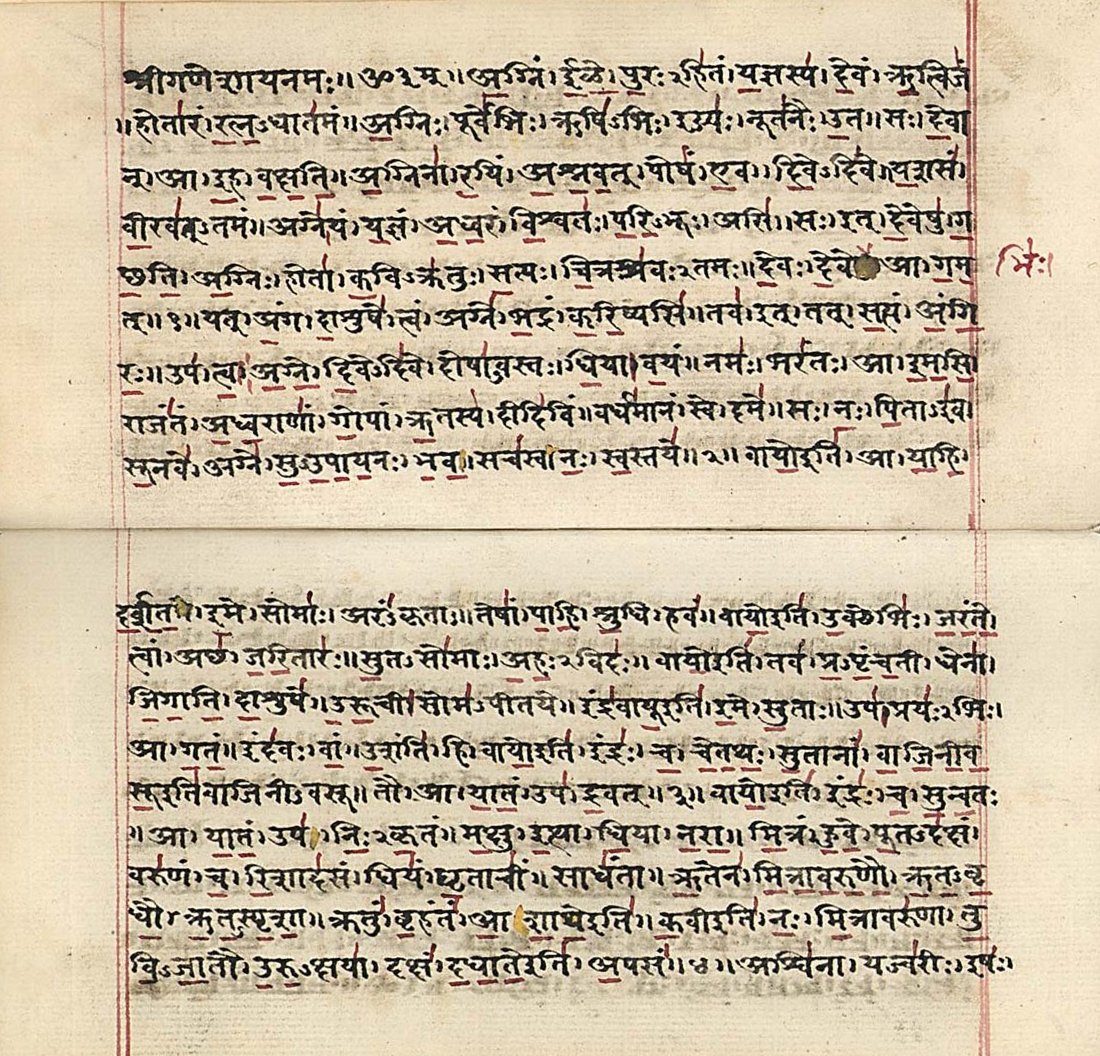
An early 19th-century manuscript of Rigveda (padapatha) in Devanagari.
History books in India try to ignore the dominant Hindu ethos of the country and its history before the Islamic period. India’s greatest historical and cultural document, the Mahabharata and Ramayana are hardly given any attention in the schools. So too, the Vedas, Puranas, Buddhist Jatakas and other prime historical and cultural documents of the country are ignored because of their religious overtones. If they do address India as a nation, it is only India of the independence movement that they acknowledge, as if prior to 1947 India did not really exist. While Nehru is made important, older kings from the Rigvedic Bharatas to Yudishthira of the Mahabharata period to the Marathas of the eighteenth century are hardly mentioned. There is no real sense of any historical continuity to the culture, much less to the country. While Mahatma Gandhi is emphasized, the greater spiritual traditions of India and its great teachers from the Vedic rishlS, Vedantic Buddhists and Jain sages to modern savants like Sri Aurobindo and Ramana Maharshi are not given much attention.
It is true that history should not be a mere instrument of a destructive nationalism and should avoid instilling aggression against other lands and peoples, even when upholding what is valuable in a nation’s history. But this does not require that the national value of historical studies is negated altogether.
The question, therefore, is how the history accounts in India made to reflect and instill a genuine nationalism and sense of the country’s history and destiny. India, after all, is one of the great civilizations of the world, with cultural traditions that have much value for humanity. Such historical accounts must reflect the richness and diversity of Indic civilization, but they cannot ignore its unity and continuity either.
The fact is that you cannot build a nation without creating history books that instill a positive nationalism, particularly in the youth. The real danger in India is not the arising of a chauvinistic nationalism like that of Nazi Germany or Fascist Italy—which are foreign to the mentality and ethos of the country—but a lack of national spirit and historical consciousness that keeps people alienated from their roots and the country divided.

India needs a real nationalism and for this a national sense of history, pride and purpose is required. A true Indian nationalism will be rooted in an Indian ethos of dharma, spirituality and pluralism, but this does not mean there can be no national or historical pride without encouraging communalism in the country. On the contrary, a greater sense of national identity would be the best thing to counter the disintegrating influence of religious, castist and regional interests that are bringing the country down.
Therefore we must ask: Why can’t Indians connect India’s traditional ancient literature, the Vedas, with its archaeology through Harappa and the many sarasvati River sites? Why can’t Indians find national pride in their own history both on literary and archaeological levels? Why should history in India be used for national shame, rather than National pride? Why should history of India place Indic civilization out of India? These are questions that must be answered.

Western and Indic Views of History

The subject of history in the Western context is very different than in the Indian context. In the Western view, history is mainly an account of political events and economic progress, a purely outward affair. In the Hindu view, history is a means of teaching detachment, showing how great kings and kingdoms come and go in the course of time. It has an inner value as a spiritual teaching about the nature of human life and the need for liberation from worldly concerns. In the Western view, history is progressive from the crude beginnings of agriculture and village life moving forward to the present day urban culture. In the Hindu view history is cyclical, with various cultures coming and going over time as the soul seeks liberation from the phenomenal world.
The Western progressive account of history is quite flawed. For example, the first civilizations of the ancient world that we can document—including Egypt. Sumeria, India and China—did not regard themselves as the first but were aware of many cultures and kingdoms before them, particularly prior to a great flood. The civilizations that we regard as the first saw themselves as very old with many antecedents! Yet we pretend that there was nothing before them!

Mauryan building in the Barabar Mounts. Grotto of Lomas Rishi. 3rd century BCE.
In addition, the civilizations of the Third Millennium BCE, like those of Egypt and Harappan/Sarasvati India, had better urban and architectural achievements than those that followed for many centuries. Even Europe had its Dark Ages after the Roman period in which much knowledge was lost. This idea of history as linear progress is clearly not the case. While humanity has progressed scientifically, this is mainly over the past five hundred years.
On the other hand. we see a spiritual decline since ancient times and over the last century we can note a decline in culture, art, music and philosophy in Europe itself, coinciding or even caused by great advances in science.

As India is the only civilization of antiquity to survive the onslaught of time, it is the special responsibility of Indians to discover not only their own history but also that of the entire ancient world. Just as there are unquestioned distortions of ancient India, similar distortions of other ancient cultures also exist. For example, the religion of ancient Egypt, which like that of the Vedas demonstrates much occult and spiritual significance, is similarly dismissed as polytheism, idolatry or henotheism (worshipping different Gods as the supreme God), exactly like the Vedas.
Revamping the way history is taught in Indian schools would be a major step in the direction of a more authentic and spiritually sensitive history of the world. It is a scientific and spiritual imperative, not only for India but for all countries.
[Excerpted from the David Frawley’s book Hinduism and the Clash of Civilization. ]

Source: indiafacts

Wednesday, 16 September 2015

एक रैंक एक पेंशन का दुष्प्रचार (OROP) भाग -1

पिछले कुछ दिनों से लगातार देश के इलेक्ट्रॉनिकप्रिंट और टीवी जैसे आम जनता तक पहुँच रखने वाले प्रजातंत्र के चौथे स्तंभ का प्रयोग देश की सुरक्षा सेनाओं के तीनों अंगों (थलसेनावायु सेना और जल सेना) के भूतपूर्व सेवानिवृत सिपाहियों की एक रैंक एक पेंशन की शांतिपूर्ण माँग को भ्रमित कर कुछ सरकारी अधिकारी देश के आम नागरिकों और नेताओं को नाकि केवल गुमराह कर रहे है वरना सिपाहियों के खिलाफ दुष्प्रचार कर उन्हें बदनाम करने की साजिश कर रहे हैं. मेरा यह प्रयास है कि देशभक्त सैनिकों के साथ होने वाले अन्याय और नौकरशाहों की घिनोनी साज़िशों से भारत की सेना का सर्वोच्च सम्मान करने वाली जनता को सत्य से अवगत करवाना है.

भारत की शांति प्रिया जनता शायद इन तथ्यों से अवगत नहीं है कि किस तरह भारत के चंद नेताओं ने अपनी झूठी शान और आत्मग्लानि को पूरा करने के लिए सशस्त्र बलों को ना कि कमजोर किया बल्कि अपनी कुंठा को दूर करने के लिए देश औरसेना के साथ छल भी किया|

इतिहास के पन्नों से

15 अगस्त 1947; को जब भारतवासियों ने 1100 सालों की गुलामी के बाद आज़ादी पाई; तो पूरा भारत खुशी से झूम उठा;जहाँ भारत के सशस्त्रबलों (थलसेनावायुसेना एवम् जलसेना) ने तिरंगे को सर्वोपरि रखकर देश की संप्रभुता एवम् अखंडता को बनाए रखने की शपथ लीवहीं कुछ नेताओं और नौकरशाहों ने सेनाओं की निजी संप्रभुता को स्वार्थों के कारण अपने हाथों की कठपुतली बनाने की कोशिश कीजिसका पहला परिणाम 1954 में जम्मू और कश्मीर में सेना के उच्चाधिकारी और नेताओं के बीच होने वाली बहस का नतीजा था | इस सिपाही और नेता नौकरशाहों के टकराव के परिणाम देश के लिए बहुत ही घातक और सेना के प्रति नेताओं की घृणित सोच का जन्म हुआक्योंकि जहाँ एक तरफ जम्मू और कश्मीर के नेता नेहरू जी के बहुत करीबी थे वही दूसरी तरफ नेहरू जी का सेना के बारे में जानकारी की कमी भी मुख्य वजह रही है|

जब इस घटना का पता प्रधानमंत्री जवाहरलाल नेहरू जी को चला तो उन्होने नेताओं और नौकरशाहों का साथ देना उचित समझा और सेना की सर्वोच्चता के काल्पनिक भय की वजह से सेना को अपमानित करने की साज़िशों पर साजिशें रच डाली |असहज भय की वजह से कि कहीं सेना ज़्यादा मजबूत ना हो जाए; तो सेना को नीचा दिखाने और नेताओं तथा नौकरशाहों का गुलाम बनाने की साजिशें रचनी शुरू करदी |

इस साजिश के पहले परिणाम का पर्दाफाश तब हुआ जब नेहरू ने कृष्णा मेनन को रक्षामंत्री (17 April 1957 – 31 October 1962) नियुक्त किया | दुर्भाग्यवश वो कृष्णा मेनन जिसको रक्षा का क, ख, ग का पता नहीं था वो भारत के सेनाओं के प्रमुख बन गये और चमड़े के सिक्के चलाने लगे | नेहरू जी ने सेना के खिलाफ हर वो कदम उठाया जिससे हमारी सेनाओं को कमजोर किया जाय और उन्हें भारत माँ और भारतवासियों की सेवा ना कर नेताओं का गुलाम बनाया जा सके | प्रधानमंत्री नेहरू और कृष्णा मेनन की साजिश का पहला शिकार थलसेना अध्यक्ष जनरल के एस थींमईया बने जिन्होने 1959 में रक्षा मंत्री की ग़लत नीतियों के विरोध में सेना प्रमुख से त्यागपत्र दे दिया था. भले ही बाद में त्यागपत्र वापिस लिया ओर 1961 में सेवानिवृत हुए;  लेकिन सेना और नेताओं नौकरशाहों के बीच में मेनन ने कभी ना भरनेवाली अविश्वास की दरार डाल दी | जहाँ सेना पूरी सत्यनिष्ठा और देशभक्ति से ओतप्रोत हो कर देश सेवा में सदैव लगी रही; वहीं नेहरू और मेनन ने परोक्ष रूप से तो सेना का सम्मान का ढोंग किया और उसके विपरीत अपरोक्ष रूप से सशस्त्र बलों को नीचा दिखाने की साजिशें रची जाने लगीं इसी दौरान नेहरू ने सभी राज्यपालों को सेना के उच्च अधिकारियों को देने वाले सम्मानों में शामिल ना करने की राजनीतिक चाल चली वो अभी भी कायम है |

सेना की छवि का पतन जो नेहरू की कुंठित मानसिकता से शुरू हुआ वो आज तक बदस्तूर जारी है | कृष्णा मेनन की बीमारू सोच का विनाशकारी परिणाम 1962 की भारत-चीन युध में भारतीय सेनाओं की प्रत्येक भारत-चीन सीमान्त इलाक़े में हुई लड़ाई का घातक परिणाम जवानो को अपना जीवन बलिदान देकर करना पड़ा भारतीय सेना केवल नेहरू और मेनन जैसे नेताओं और नौकरशाहों की उपेक्षा का शिकार ही नहीं हो रही थी वहीं दूसरी तरफ युध के लिए ज़रूरी गोला-बारूदहथियार और रसद आदि की भारी कमी की भी परेशानियों से जूझ रही थी दुर्भाग्या से जितनी बार सेना ने मेनन को युध के लिए तैयारियों की कमी के बारे में बताया; वह एक रसोइए की तरह जवाब देता जब ज़रूरत पड़ेगी तो समान लाकर खाना बना लेंगे ऐसे नेता, भारतीय सेनाओं को विरासत में मिले जो अच्छे प्रवक्ता और स्वार्थी अभिलाषी थे परंतु अपने ही देश की सेनाओं के प्रति डरी हुई घटिया सोच रखते थे |स्वर्गिया श्री जगन्नाथ बी ए ने कहा था "अगर नेहरू और मेनन की जोड़ी 1965 के भारत-पाक युध में होती तो इस बात में कोई शक नहीं कि आयूब ख़ान दिल्ली में ही नाश्ता करता" |

मेरे मन भी आज एक शंका है कि नेहरू को भारतीय सेनाओं से किस बात का डर था जो उन्होने सेना को नीचा दिखाने के प्रयास में लगभग पूरा लदाख ही चीन को गवाँ दिया होता?

क्या देशवासियों को पता है किअगर सेना में देशभक्ति और भारत माँ के लिए बलिदान का प्रेम और जनूंन ना होता तो चीन की सेनाओं को मौजूदा सीमा पर रोक पाना असंभव था परंतु यह बात ना नेहरू और ना मेनन ही समझे हमारे सैनिक लड़ाई के हर सामान और रसद की अभूतपूर्व कमी के बावजूद अपने मोर्चों पर लड़ते लड़ते भारत माता की जय और जय हिंद के युधघोष करते हुए वीरगति को प्राप्त हो गये बेशर्म नेता इन देशभक्त सिपाहियों का भी अपमान करने से नहीं हिचकिचातेगद्दार कहीं के हज़ारों भारतीय सिपाही नेताओं की मानसिक कुंठा और नफ़रत को जानते हुए भी देशवासियों और भारत माता की रक्षा के लिए हंसते हंसते अपने प्राणों का बलिदान कर वीरगति को प्राप्त हुए |

Wife of Soldier Kalpna Sharma candle march at India Gate 23 Aug 15

जय जवान जय किसान 

नेहरू की मृत्यु के पश्चात;  श्री लालबहादुर शास्त्रीजी ने देश के दूसरे प्रधानमंत्री बनने के बादभारतीय सशस्त्रबलों की ज़रूरतों पर ध्यान दिया | उन्होने नये रक्षा मंत्री यशवंतराव चौहान (14 November 1962 – 14 November 1966) को सेनाओं के पुनर्गठन में तेज़ी लाने की हिदायत दी पाकिस्तान के हुक्मरानों ने 1962 भारत-चीन की लड़ाई से लेकर नेहरू की मृत्यु के समय तक हमारी सेना को एक कमजोर विरोधी के रूप में देखा पाकिस्तान की इस सोच के पीछे अमरीका से लाए गये अत्याधुनिक सैनिक हथियार और टेंक थे जो हर तरह की लड़ाई में भारत की सेना के सामान से अच्छे थेपाकिस्तान की और से युधस्तर की तैयारियों को ध्यान में रखकर हर संभव मदद दी जाए | शास्त्री जी ने पाकिस्तान की तरफ से की जाने वाली युध की तैयारियों की खबरो को ध्यान में रखते हुए सेना को लड़ाई के लिए ज़रूरी साजो सामान की व्यवस्था के आदेश भी दिए इससे पहले की भारतीय सेना पूरी अपनी युध की तैयारी और युधाभ्यास में सॅक्ष्म हो पातीपाकिस्तान ने अगस्त 1965 को जम्मू और कश्मीर में आक्रमण कर दिया इस विकट परस्थिति में भी भारतीय सेना ने पाकिस्तान को मुँहतोड़ जवाब दिया बल्कि 23 सितंबर 1965 युदविराम होने तक दुश्मन की बहुत सारे इलाक़े पर कब्जा कर लियाएक बार फिर नेता और नौकरशाहों ने सेना के मनोबल को नीचा करने का काम किया और शास्त्री जी की मर्ज़ी के खिलाफ ज़्यादातर जीते हुए इलाक़े पाकिस्तान को लौटा दिए गये|  

शास्त्री जी जिन्होने सशस्त्र बलोंकिसानों और भारतवासियों को आ नया नारा जय जवान ज़य किसान का नारा देकर अमर हो गये. क्या शास्त्री जी भारत के साथ होने वाले अन्याय को सहन नही कर पाए और आत्मग्लानि या किसी अन्य साजिश के तहत अपने प्राण बलिदान कर गये ||

सेनाओं का विपरीत परिस्थितियों में अदम्या साहस

भारतीय सेनाओं की अदम्या साहस और विपरीत परिस्थितियों में भी देश की सुरक्षा और अखंडता को बनाए रखने के अद्भुत योगदान को; जहाँ एक तरफ देशवासियों ने खूब सराह; वहीं दूसरी तरफ नेता और नौकरशाह; सेनाओं के खिलाफ छलकपट और फरेब की नई-नई साजिशें रचने में लगे हुए थे जबकि सब राजनीतिग और नौकरशाह जानते थे कि मजबूत और सूद्रढ सेना ही देश की सीमाओं की रक्षा बाहरी आक्रमणों से कर सकती है | पहले नेहरू और फिर इंदिरा गाँधी ने  नौकरशाहों के कहने पर सेना को कमजोर करने की चालें लगातार चली; जिससे सेना का मनोबल गिरे और नौकरशाह देश की भोली-भली जनता और देशवासियों को मुस्लिम हुक्मरानों की तरह बे-रोकटोक लूटते रहें और शासक बन कर छल की चालें चलते रहें सन् 1970 का दशक आते-आते जब पाकिस्तान की फिर युध तैयारियों का पता चला तो सेना के उच्चाधिकारियों ने प्रधानमंत्री और रक्षामंत्री को भारतीय सेना की कमियों के बारे में अवगत कराया; तो काफ़ी समय बर्बाद करने के बाद नेता-नौकरशाह गठबंधन ने सेना को ज़रूरी युद्ध के सामान को प्राप्त करने का निर्णय दिया |

पाकिस्तान ने सन् 1971 (3 December 1971 to 16 December 1971) एक बार फिर भारत पर आक्रमण कर दिया और जम्मू कश्मीर से लेकर पूर्वी पाकिस्तान (मौजूदा बांग्लादेश) से लगी हर सीमा पर घुसपैठ शुरू करदी | भारतीय सेनाएँ एक बार फिर पुराने,बेकार और घटिया किस्म के सामान के लेकर सर्वोच्च मनोबल के साथ युध की तैयारी में लग गयीथलसेना अध्यक्ष फील्ड मार्शल साम मानेक्शा के कुशल मार्ग दर्शन के नीचे भारतीय सेनाओं ने मात्र 16 दिनों में ही पाकिस्तान के पूर्वी हिस्से को काटकर नया इतिहास रचा और नये राष्ट्र बांग्लादेश को आज़ाद करवा दिया एक बार फिर इस निर्णायक युध में नेताओं और नौकरशाहों का सेनाओं के प्रति अविश्वास और धोखे की चालों का तब पता चला जब सेनाओं के प्रमुखों का इंदिरा गाँधी और रक्षा विभाग के अधिकारियों से युधौपरांत संपर्क हुआ |


सिपाहियों के पेट पर लात

Author with RHS Members at Jantar Mantar on 21Aug 2015

    इंदिरा जी की बार
-बार चेतावनी के बाद भी जब थलसेना अध्यक्ष फील्ड मार्शल साम मानेक्शा ने युध में अधूरी तैयारी के साथ जाने से मना कर दिया तो उस समय तो वो कुछ नहीं कर सकीं लेकिन 1971 भारत-पाक युध फलस्वरूप बांग्लादेश के जन्म होने के बाद नेहरू जी की ही तरह सेना को कमजोर करने के खिलाफ एक और साजिश रच डाली ; जिसके परिणाम हमारी सेनाएँ आज तक भुगत रही हैंमें इस छल कपट और फरेब की साजिश को देशभक्त सेनाओं के साथ किए जाने वाले अपराध की सबसे बड़ी प्रकाष्ठा मानता हूँ; क्योंकि इंदिरा गाँधी ने इस नीति से सिपाहियों के पेट पर लात मारी थी और हज़ारों वीर नारियों और शहीदों की विधवाओं के मुँह से दो समय की पूरी रोटी का निवाला भी छीन लेने की कोशिश की थी |

सबसे पहला सिपाहियों के पेट पर लात मारने का सुझाव खुद प्रधानमंत्री ने दियाजहाँ 1971 के भारत-पाक युद्ध की अभूतपूर्व सफलता के लिए भारतीय सेनाओं को सम्मानित करना चाहिए था; वहीं इंदिरा जी ने नौकरशाहों के कहने पर सेना को शनिवार और रविवार के दिन विश्राम का नाम देकर वेतन काटने का प्रस्ताव दे डाला बेशर्मी की सारी हदें पार करने की तरफ एक और घिनोना कदम थाथलसेना अध्यक्ष ने प्रस्ताव सहर्ष यह प्रार्थना करते हुए स्वीकार कर लिया कि अगर चीन या पाकिस्तान शनिवार और रविवार को आक्रमण करते हैं तो सेना युद्ध नहीं करेगी आप देश की दूसरे बलों को लगा सकती है शायद इंदिरा गाँधी और नौकरशाहों को ऐसे उत्तर की स्वप्न में भी कल्पना नहीं थी वो काँप उठे और स्थिति को बदलते हुए कहा हम तो मज़ाक कर रहे थे | कितने शर्म की बात है कि देश की प्रधानमंत्री थलसेना अध्यक्ष के साथ भारतमाता की सुरक्षा को लेकर भद्दा मज़ाक कर रही थीबेशर्म नेता और देशद्रोही सोच वाले अधिकारी जिन्होने सेनाओं को पुलिस की तरह गुलाम बनाने की हर साजिश रची परंतु देशभक्त और देशप्रेम से लबालब सेना ने देश की सुरक्षा में कोई कमी नहीं रखी |

श्री जगन्नाथ बी ए ने 1973 के बाद कहा था भारतीय सेनाएँ कभी भी देशद्रोही नेताओं और अधिकारियों को सबक सीखा सकती है परंतु उनकी भारत माँ और भारतवासियों के प्रति देशभक्ति का प्रेम रोक रहा है" क्या यह सच्च नहीं ?

पुनः सशस्त्र बलों के खिलाफ नयी साजिश 1973 में नौकरशाहों ने बहुत ही घिनोनी लोमड़ी और गीदड़ की संकीर्ण मानसिकता का परिचय देते हुए नये वेतन के मापदंडों को निर्धारित करने के समय रची  | भारतीय सेनाओं के हाजिर सेनिकोंउनकी वीर विधवाओं और सेवानिवृत सैनिकों के पेट पर जोरदार प्रहार उनके वेतन में छलविश्वासघात और धोखे का उदाहरण पेशकिया|नौकरशाहों ने एक ऐसी साजिश के तहत सेनाओं के लिए जो वेतन मापदंड निर्धारित किए; वो आजतक भारत के किसी भी युवक को सेना में सेवा के लिए प्रोत्साहित नहीं कर सके फलस्वरूप भारतीय सेनाएँ आज तक भूतपूर्व सैनिकों के वंशजों पर ही चल रही है |नौकरशाहों द्वारा 1973 की वेतन नीति के तहत जो लात सिपाहियों के पेट पर मारी उसका असर सैनिकों के परिवारोंबच्चों की शिक्षा और उनके पालन पोषण पर शीघ्र ही दिखने लगा |

सैनिकों की सेवानिवृत पेंशन मापदंड निर्धारंण में छल

नौकरशाहों ने जब 1973 के वेतन मापदंड तय किए तो जहाँ उन्होने अपने सेवानिवृत कर्मचारियों के लिए सेवानिवृत पेंशन उस अधिकारी की आख़िरी वेतन के 33% हिस्से को बढाकर 50% कर दिया; वहीं सशस्त्र बलों के सैनिकों की पेंशन को 70% से घटा कर 50% कर दिया गया सेना को नौकरशाहों के सेवानिवृत कर्मचारियों के वेतन बढाने से कोई आपत्ति नहीं है; परंतु आपत्ति है तो वो यह कि देश पर प्राण न्योछावर् करने वाले सैनिकों से साजिश के तहत गद्दारी की गयी थी | इन सभी धोखों के बावजूद; सेना के सिपाही अपने परिवारों की आर्थिक तंगी से युक्त समस्याओं को अलग रखते हुए; इस उम्मीद में देश की सेवा करता रहा; कि हमारे अधिकारी; नेता और नौकरशाह  सैनिकों की घरेलू समस्याओं का समाधान कर देंगे शायद यही उम्मीद आज जंतर मंतर पर सैलाव बनकर उमड़ रही है;  जो हर सैनिक और उसके परिवार की आर्थिक समस्याओं का मुख्य कारण बन गयी 

जब भूतपूर्व सैनिको को इस अन्याय का पता चला तो उन्होने नौकरशाहों की इस नाइंसाफी के खिलाफ शांति पूर्वक वार्तालाप किया. सन् 1982 में सेवानिवृत कर्नल इंदरजीत सिह और अन्य सैनिको ने वन रेंक वन पेंशन (ओरोप-OROP) का मुद्दा तत्कालीन प्रधानमंत्री और रक्षामंत्री इंदिरा गाँधी के समक्ष उठाया प्रधानमंत्री ने पूरे विश्वास के साथ भरोसा दिलाया कि इस त्रुटि को दूर कर सैनिकों के साथ पूर्ण न्याय होगा श्री जगन्नाथ बी. ए. ने जब यह सुना कि श्रीमती इंदिरा गाँधीं ने ऐसा आश्वासन दिया तो वह हंसते हुए व्यंगात्मक भाव में बोले "क्या कभी, बैल भी दूध देता है" केवल एक और धोखा है |

ओरोप (OROP) के खिलाफ सोची-समझी साजिश

जिस देशप्रेम से भारतीय सेनाएँ देशवासियों क़ि सेवा में तत्पर रहती हैं सैनिकों की उस देशभक्ति की भावना का नेताओं ओर नौकरशाहों ने बार-बार अपमान किया इस बात की सत्यता भूतपूर्व सैनिकों द्वारा बार-बार शांतिपूर्वक किए जाने वाले विरोध से झलकती हैइंदिरा गाँधी जी के मृत्यु के बाद सैनिकों ने फिर राजीव गाँधी से प्रार्थना की पहले तो राजीव गाँधी ने अपनी स्वर्गीय माँ को श्रदांजलि देने की बात कह कर भरोसा दिलाया; लेकिन जब नौकरशाहों ने छल का पैंतरा फैंका तो बिना किसी सहयोग और स्पष्ट नीति के आठ वर्ष बेफ़्कूफ़ बनाते रहे जब भूतपूर्व सैनिकों ने पुनः प्रार्थना की तो राजीव गाँधी ने 1991 के चुनावों तक इंतज़ार करने को कहालेकिन राजीव गाँधी की हत्या से एक बार फिर सैनिकों को निराशा ही हाथ लगी |

ऐसी कौन सी माँगे भूतपूर्व सैनिकों ने रखी थी जिसको तो भारतीय प्रधानमंत्रीरक्षामंत्री और नौकरशाह पूरी करने में 1982 से लेकर आज 23 अगस्त 2015 तक असमर्थ लग रहे हैं |