NaMo NaMo

Namo Event

Showing posts with label Spirituality. Show all posts

Sunday, 13 March 2016

American Progressives also typify others: Olmsted and Pollock

There are striking parallels between the seemingly progressive yet deeply prejudiced views of leftist American intellectuals of the 19th century and today.
by Kausik Gangopadhyay


Sene One: Mid Nineteenth Century 

Abolition of Slavery is a landmark event in American History. At the peak of American Civil war, President Abraham Lincoln abolished slavery as a strategic move to win the war through the Emancipation Proclamation (1863). Planters in the Southern states of America used to justify slavery on the ground of supposed racial inferiority of the Negros and need of Slavery as an institution for the benefit of the Negros. But what was the role of progressive American intellectuals of that era regarding abolition of slavery?

The voice against slavery was gaining ground in the preceding decades. This may give the reader an impression that progressive intellectuals sympathetic to abolition of slavery believed in equality of all races, as opposed to those conservatives who supported slavery as the right institution for upliftment of blacks. Such an understanding, however, would be deeply flawed.

Frederick Law Olmsted was a versatile personality of that era. He was a farmer as well as a landscape architect, journalist, social critic and public administrator. He was commissioned by the New York Times editor in 1852 to prepare a series of articles about Slavery in the south. His famous book, The Cotton Republic (1861), was based on these articles which presented an all-encompassing picture of slavery. Eminent personalities of that era, including Karl Marx, were influenced by Olmsted's views. What were Olmsted's views exactly? He was firmly against slavery — not primarily because of exploitation of the slaves but mostly on account of the supposed inefficiency of the slaves who, in his understanding, accomplished one third to one half as much work as did “the commonest stupidest domestic drudges at the North.”

It is not Olmsted alone but other contemporary progressive intellectuals of the United States of the time such as Cassius Marcellus Clay and Hinton Rowan Helper had similar opinions, which formed the core of anti-Slavery argument of those times.

Do their arguments make sense? Absolutely Not. Eminent economic historians of the twentieth century—Robert William Fogel and Stanley L. Engerman—analysed American slavery in their book Time on the Cross (1974) for which Fogel was awarded the Nobel Memorial Prize in economic sciences. Their data-based work did dispel many popular false perceptions about slavery, in particular, the myth of Negro slovenliness. The Negros were definitely more hard working and more productive than free white labourers. 

Fogel and Engerman further explain,

 “The antislavery critics...conceived of blacks as members of an inferior race...Most expected that freed Negroes would have to be constrained in various ways if an “orderly” society was to be maintained.”

No wonder, “one of the biggest biological crisis of the nineteenth century” happened right after abolition of slavery when at least one quarter of the four million former slaves got sick or died between 1862 and 1870. (Jim Downs, Sick from freedom; 2012)

Scene two: Early Twenty-first century

 A large number of American academics probably do not recognise Indian civilisation anything worthy of cognisance. The present West—American society being certainly at the forefront—is the product of the European renaissance in the Middle ages, which awakened the scientific exploration and risk-taking ventures of the West. At the heart of this revolution, argues Peter L. Bernstein in his book Against the Gods (1998), lies the Hindu-Arabic number system developed by the Indian civilisation and passed over to the West by the Arabs.

 Sheldon Pollock is a scholar and a leading expert on Sanskrit. Pollock, a chaired professor in a reputed US university, is the editor of the Murty Classical Library of India, a project launched to translate many volumes of Indian classics into English. This shows identification of Pollock with the cause of Indian civilisation. Rajiv Malhotra's book, The Battle for Sanskrit (2016), summarises Pollock's views on Sanskrit and Indian culture. Pollock considers Sanskrit a Brahminical project and source of oppression in India. Sanskritic hegemony, Pollock feels, deprived India of all creativity. The Ramayana, according to him, is a socially irresponsible book.

 Sanskrit connotes to the language of the cultured people by etymology. But Sanskrit is not really an exception; in civilizational projects, languages often evolve from the high culture of society and their names are indicative of this feature. For example, Mandarin is the imperial lingua franca of China (the language of the bureaucrats); Hebrew and Turkish are two artificially revived languages of the twentieth century by the cultural elites of the respective nations. Nevertheless, two most prominent compositions of Sanskrit, the Ramayana and the Mahabharata, are both composed by authors belonging to the subaltern classes (left liberal terminology wise)—Valmiki was a highway robber and Vyasa illegitimate Child of a boat-woman. These epics form the heart and the soul of Indian culture. What can be better proof of the fact that Sanskrit integrated the masses of India?

 Pollock is—very crucially—factually wrong too. He considers circa 260 BC as the birth of writing in India, overlooking the extensive evidence of writing found in Harappan sites (second or third millennium BC). Moreover, days when Sanskrit was India's lingua franca, India was one of the most advanced country of the world in terms of science, technology and economic prosperity. It is quite naive to insinuate that Sanskrit is responsible for Indian inferiority (the claim of Sheldon Pollock).

Progressive Typification

 The world-views of two leading progressive scholars of two very different generations show a similar pattern. Indeed, two examples are, by no means, sufficient to make a complete evaluation of the American progressives. However, they may bust some myths about American Progressives and their world-view which is often projected as neutral to race and religion.

 A. Olmsted was for abolition of slavery but strongly believed in inferiority of the Negroes. Pollock is associated with promotion of Indian civilisation but strongly believes in inferiority of Indian civilisation.

 B. Olmsted was factually wrong and prejudiced to consider the slaves as slovenly; but he pretended to be objective. Pollock's worldview has also factual inconsistencies as explained above. He is supposedly objective; so it does invoke the question: does he nurture deep prejudices in his psyche?

 C. Olmsted wanted Negroes to be constrained in an orderly society; he could not imagine a complete equality of the races. Pollock wants to send Sanskrit to museum as a dead language. He is utterly against revival of Sanskrit. Parity of Indian civilisation to its western counterpart is an unacceptable idea for him.

 D. Though slavery was no progressive institution, slaves did survive as second class inhabitants in American society with receipt of almost 90% of payment made to the free workers (Fogel and Engerman, 1974). There was no systemic genocide by slave-owners. However abolition of slavery caused Negroes to perish in unprecedentedly large numbers during 1860s. Likewise, American conservatives are no friends of Indian culture. Indian cultural studies—while being dominated by western academic discourse—can survive without any state patronage from them. But it is difficult to conclude the same with Pollock as gatekeeper for Indian culture. Such a “friend” of Indian culture would probably end up being catastrophic.

Source: pragyata

Thursday, 31 December 2015

OMG! You Wont Believe Star Wars is Based on These Two Famous Ancient Indian Texts. Read the Truth!

The Jedi in the Lotus: An Eastern Look at Star Wars
By Steven J. Rosen
This book looks at the underlying basis of George Lucas' successful film series, showing how it is, in many cases, based on Indic texts, such as the Ramayana and the Mahabharata.

Naturally, the market for this book is not only students of Hinduism and Eastern spirituality – my usual market – but also fans of the film series, which amounts to literally millions of people. When the Phantom Menace (the first Star Wars prequel) came out in 1999, it was hailed as the most anticipated movie of all time, and it did incredibly well at the box office. What's more, when the video and DVD were recently released, the sales were unprecedented. Now, the next film in the series is due out this month (May 2002), and fans say that this will be the best of them all. Six months after that, Lucasfilms will release the video and DVD of that film, and two years later, the final installment of the Star Wars series is scheduled for release, meaning that the epic fantasy series will be on people's minds for years to come. I ask those of you associated with the Infinity Foundation to help me find a publisher for this work. Time is of the essence.

An outline of my book is as follows:
o The introduction reveals the basic connection: It describes how myths are embedded in the consciousness, in the soul, and have therefore manifested in similar ways throughout the world. Ancient Indian myths are perhaps the earliest examples of these world myths, while Star Wars is merely among the most contemporary. The correlations are many, and they will all be explored throughout the book. I look at George Lucas' major influences, from Flash Gordon to Joseph Campbell, and how Indian tales form the central core around which his series is modelled.

o In Chapter One, I elaborate on the story of Rama as well as that of the Pandavas. In addition, I outline the chronology of events in Star Wars and show overlapping themes and points of similarity and difference.

o Chapter Two explains "the Force," showing its correlation with both Maha-Maya (God's external energy of illusion) and Yoga-Maya (God's internal positive spiritual energy), since The Force has both bad and good dimensions. I will also compare the Force to various manifestations of shakti and to Brahman, the impersonal aspect of the Supreme, for there is much similarity in these concepts. Students of Indian religion will balk at the East-Indian ideas Lucas freely uses when constructing his idea of the Force.

o The Third Chapter will explain the underlying message of the Star Wars films, especially its idea that light and dark aspects of reality can be analogized with Nature vs. Machine paradigms. Each film in the Star Wars series offers food for thought regarding the "organic as opposed to the mechanic," and our Third Chapter will look at them all.

o Perhaps most importantly, in the Fourth Chapter, I will show that just as Star Wars takes place in deep space, most of the battles in the Ramayana take place in sophisticated aircrafts, and Arjuna, too, in the Mahabharata, is said to engage in many battles while in outer space. The Vimana shastras show that ancient India somehow knew of elaborate aircraft and boasted an awareness of advanced technology. While I point out that much of this may be relegated to the realm of fantasy, it is indeed curious that ancient texts engage these very Star Wars-like ideas.

o The Fifth Chapter will elaborate on Yoda's relationship with Luke Skywalker, which is essentially a Guru-Disciple relationship. I will explain their interaction in terms of Indian texts and show how the teacher/pupil dynamic is nowhere as developed as in India. I will also show parallels between India's system of yoga and that which is taught by the Jedi knights.

This will lead into an examination of kshatriya dharma, for the the Jedi knight concept is obviously an extrapolation of the codes of India's warrior caste.

o The Afterword will sum up the religious components of the film series and explore spiritual elements in many other similar films. In conclusion, I will show that ancient Indian traditions were well ahead of their time, and even today have much to offer the world.
Source: infinityfoundation 

Wednesday, 4 November 2015

History and Nationalism: Excerpt from Hinduism and the Clash of Civilization

One of the main purposes of history books, as taught in different countries in the world,…
One of the main purposes of history books, as taught in different countries in the world, is to instill a sense of national pride and honor—in short, to inculcate a sense of patriotism and nationalism. Whether it is the United States, Great Britain, Russia, Germany or China, this is certainly the case today and has been so as long as these countries have existed as modern nations. The lives of great leaders, particularly the founders of the country are highlighted, the continuity of the nation’s history is emphasized, and the importance of the nation in the history of world and the greatness of the national culture are stressed. Students are expected to come away from reading accounts of their history with a sense of national greatness and purpose, not only for the past but also for the future.
However, India is a strange and unique country in which history books are often anti-national in nature. India has largely kept intact the British approach to Indian history devised in the colonial era. Students of such textbooks come away apologetic or confused about their country and its traditions. Textbooks in Marxist ruled states of India like West Bengal and Kerala leave their students with a sense of the greatness of Communism and Communist countries like China or even Russia which is no longer Communist, rather than any real regard for India and its great traditions.

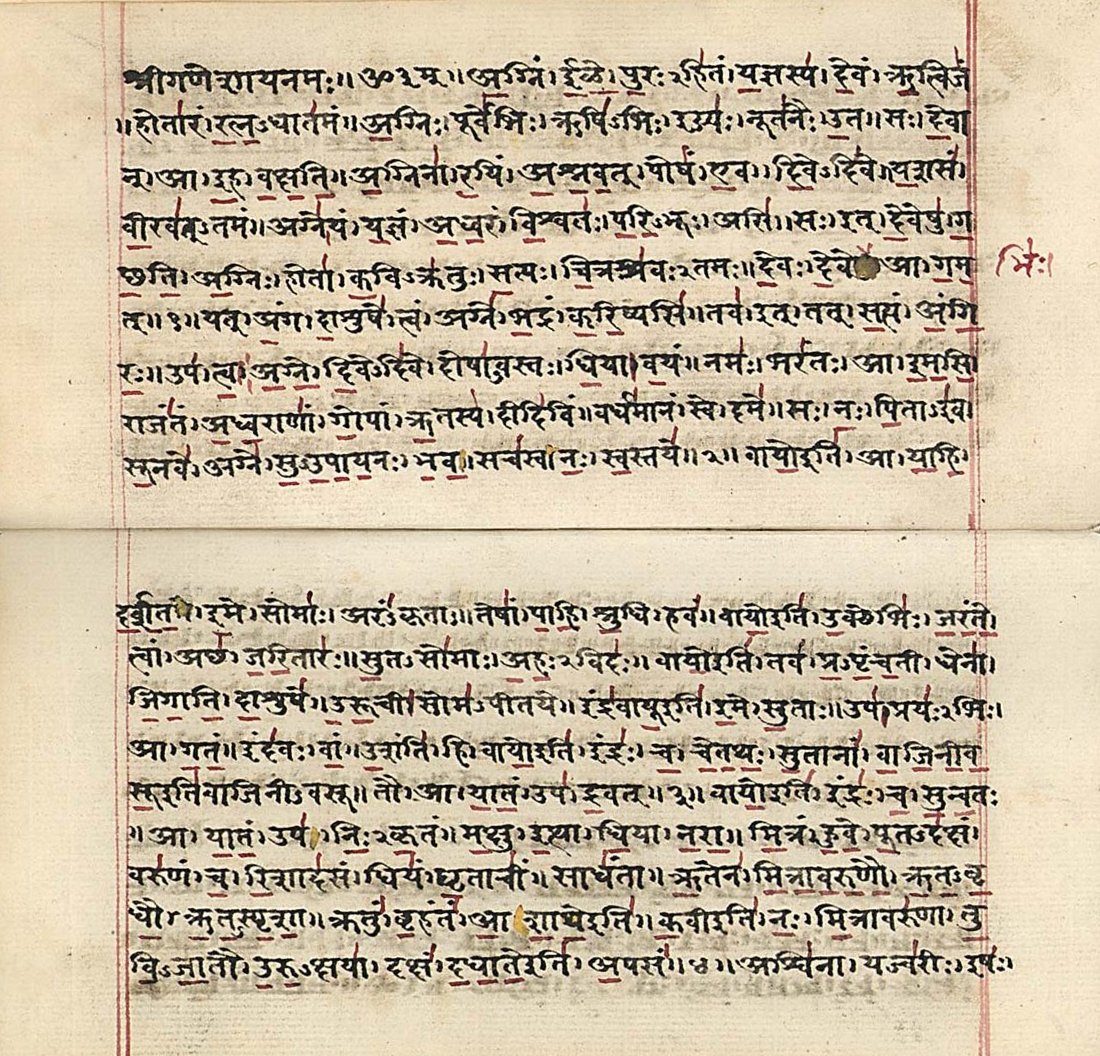
An early 19th-century manuscript of Rigveda (padapatha) in Devanagari.
History books in India try to ignore the dominant Hindu ethos of the country and its history before the Islamic period. India’s greatest historical and cultural document, the Mahabharata and Ramayana are hardly given any attention in the schools. So too, the Vedas, Puranas, Buddhist Jatakas and other prime historical and cultural documents of the country are ignored because of their religious overtones. If they do address India as a nation, it is only India of the independence movement that they acknowledge, as if prior to 1947 India did not really exist. While Nehru is made important, older kings from the Rigvedic Bharatas to Yudishthira of the Mahabharata period to the Marathas of the eighteenth century are hardly mentioned. There is no real sense of any historical continuity to the culture, much less to the country. While Mahatma Gandhi is emphasized, the greater spiritual traditions of India and its great teachers from the Vedic rishlS, Vedantic Buddhists and Jain sages to modern savants like Sri Aurobindo and Ramana Maharshi are not given much attention.
It is true that history should not be a mere instrument of a destructive nationalism and should avoid instilling aggression against other lands and peoples, even when upholding what is valuable in a nation’s history. But this does not require that the national value of historical studies is negated altogether.
The question, therefore, is how the history accounts in India made to reflect and instill a genuine nationalism and sense of the country’s history and destiny. India, after all, is one of the great civilizations of the world, with cultural traditions that have much value for humanity. Such historical accounts must reflect the richness and diversity of Indic civilization, but they cannot ignore its unity and continuity either.
The fact is that you cannot build a nation without creating history books that instill a positive nationalism, particularly in the youth. The real danger in India is not the arising of a chauvinistic nationalism like that of Nazi Germany or Fascist Italy—which are foreign to the mentality and ethos of the country—but a lack of national spirit and historical consciousness that keeps people alienated from their roots and the country divided.

India needs a real nationalism and for this a national sense of history, pride and purpose is required. A true Indian nationalism will be rooted in an Indian ethos of dharma, spirituality and pluralism, but this does not mean there can be no national or historical pride without encouraging communalism in the country. On the contrary, a greater sense of national identity would be the best thing to counter the disintegrating influence of religious, castist and regional interests that are bringing the country down.
Therefore we must ask: Why can’t Indians connect India’s traditional ancient literature, the Vedas, with its archaeology through Harappa and the many sarasvati River sites? Why can’t Indians find national pride in their own history both on literary and archaeological levels? Why should history in India be used for national shame, rather than National pride? Why should history of India place Indic civilization out of India? These are questions that must be answered.

Western and Indic Views of History

The subject of history in the Western context is very different than in the Indian context. In the Western view, history is mainly an account of political events and economic progress, a purely outward affair. In the Hindu view, history is a means of teaching detachment, showing how great kings and kingdoms come and go in the course of time. It has an inner value as a spiritual teaching about the nature of human life and the need for liberation from worldly concerns. In the Western view, history is progressive from the crude beginnings of agriculture and village life moving forward to the present day urban culture. In the Hindu view history is cyclical, with various cultures coming and going over time as the soul seeks liberation from the phenomenal world.
The Western progressive account of history is quite flawed. For example, the first civilizations of the ancient world that we can document—including Egypt. Sumeria, India and China—did not regard themselves as the first but were aware of many cultures and kingdoms before them, particularly prior to a great flood. The civilizations that we regard as the first saw themselves as very old with many antecedents! Yet we pretend that there was nothing before them!

Mauryan building in the Barabar Mounts. Grotto of Lomas Rishi. 3rd century BCE.
In addition, the civilizations of the Third Millennium BCE, like those of Egypt and Harappan/Sarasvati India, had better urban and architectural achievements than those that followed for many centuries. Even Europe had its Dark Ages after the Roman period in which much knowledge was lost. This idea of history as linear progress is clearly not the case. While humanity has progressed scientifically, this is mainly over the past five hundred years.
On the other hand. we see a spiritual decline since ancient times and over the last century we can note a decline in culture, art, music and philosophy in Europe itself, coinciding or even caused by great advances in science.

As India is the only civilization of antiquity to survive the onslaught of time, it is the special responsibility of Indians to discover not only their own history but also that of the entire ancient world. Just as there are unquestioned distortions of ancient India, similar distortions of other ancient cultures also exist. For example, the religion of ancient Egypt, which like that of the Vedas demonstrates much occult and spiritual significance, is similarly dismissed as polytheism, idolatry or henotheism (worshipping different Gods as the supreme God), exactly like the Vedas.
Revamping the way history is taught in Indian schools would be a major step in the direction of a more authentic and spiritually sensitive history of the world. It is a scientific and spiritual imperative, not only for India but for all countries.
[Excerpted from the David Frawley’s book Hinduism and the Clash of Civilization. ]

Source: indiafacts

Wednesday, 7 October 2015

The answer to life, the universe and everything

 |  6-minute read |   01-10-2015

Stephen Hawking, arguably the world’s greatest living theoretical physicist, recently stated: “We believe that life arose spontaneously on Earth. So in an infinite universe, there must be other occurrences of life.”The successful launch of space observatory Astrosat by the Indian Space Research Organisation (ISRO) on September 28 places India in an elite league of nations. The space observatory can “listen” to signals from outer space, including those from intelligent life in other solar systems and galaxies.
Polls conducted in various countries show that more than 50 per cent of people in Britain, Germany and France believe that intelligent life exists in other parts of the universe. According to a recent report by Katrina Pascaul in Tech Times, “A new survey has found that more than one in two individuals in the United States, United Kingdom and Germany believe there is intelligent life out there in space. According to new YouGov research, the majority of the public in these three countries believe that living entities, which have the ability to communicate and do not hail from Earth, exist. Findings show that more than half of Germans (56 per cent) believe this, the most likely to do so among the survey participants. Fifty-four per cent of Americans and 52 per cent of British people share the opinion. The British people who believe alien life exists say the most likely reasons for the paradox are that intelligent life is too far away for us to be able to contact it, and that our technology is not advanced enough for communication.”

Other reports confirmed that Hawking is supporting “the biggest and most ambitious search plan yet (in which) astronomers plan to study more than ten times more space than ever before in and around the Milky Way and neighbouring galaxies in a bid to seek out potential radio emissions that could come from advanced civilisations. The project, known as Breakthrough Listen, comprises a $100 million, ten-year search, launched by the Breakthrough Initiatives group at the Royal Society in London. The research will survey one million stars in the Milky Way, as well as the stars in the 100 closest galaxies.”
As an undergraduate student of physics, the first paper I wrote was on the possibility of intelligent life in the universe. The answer seemed self-evident: the universe must surely teem with intelligent life. The problem is we are Earth-centric. Life in outer space need not be humanoid. The laws of physics are still evolving. Plasmoid life and indeed life beyond anything we can imagine today is possible. The law of probability underscores the reason for life in outer space being a virtual certainty. Here’s why:
1. There are at least one hundred billion galaxies in the observable universe.
2. Our own galaxy, the Milky Way, has several hundred billion solar systems.
3. Our sun constitutes just one of these solar systems.
4. Several million, possibly billion, solar systems in the observable universe have planets with environmental, atmospheric and chemical conditions suitable to harbouring life.

Prior to “Time Zero”, the stage when the universe was created, there was – literally – nothing. A perfect vacuum. From that vacuum has emerged everything in the universe – atoms, stars, galaxies, black holes, quasars, dark matter, planets – and, on Earth, life.

At the point of “singularity” when there was nothing, in that fraction of a fraction of a second before the Big Bang that created the universe, lies the greatest mystery physicists and mathematicians like Hawking and Roger Penrose continue to wrestle with. What precisely was the event that created this universe from a perfect vacuum at the point of singularity?

Hawking calls these the most important questions facing humankind: How did the universe emerge at the point of singularity from a perfect vacuum at Time Zero? Are we alone in the universe? And finally, why does the universe exist at all?

This is where science, philosophy and faith intersect.

Within this absolute space-time vacuum (postulated by the Hawking-Penrose singularity theorems based on Einstein's general theory of relativity), an event occurred which no leading scientist has yet been able to fully explain. That event probably involved the mutual annihilation of a positron-electron twin pair carrying identical (positive and negative) charges and mass. The result of this vacuum fluctuation was the Big Bang, the widely accepted theory of how our universe began.

Before Time Zero, during the pre-universe "nothingness", it is hypothesised that constant and instantaneous mutual annihilation of positron-electron pairs occurred several trillion times every second. These multiple collisions cancelled each other out, leading to a perpetual state of zero mass, zero time and zero space – the perfect vacuum. The mutual annihilation of electrons and positrons, however, occurred in unimaginably small crevices of time – 10-100 seconds or less.

To the observer nothing was occurring: the event started and ended before it could be observed and therefore, as far as the observer was concerned, had not occurred at all. From this nothingness a freak, once-in-a-quadrillion positron-electron pair escaped mutual annihilation 13.70 billion years ago, causing the Big Bang and the creation of our universe as well as a "mirror" negative universe.

Are we alone?

Our nearest solar system is Alpha Centauri. To get there, travelling at the speed of light, would take 4.3 years. Travelling at the speed of the world's fastest experimental spacecraft, Helios II (1,57,000 mph), it would take over 12,000 years to reach Alpha Centauri. Other solar systems are even further off. Galaxies are, of course, trillions of miles away. Our galaxy, the Milky Way, contains around 350 billion solar systems – many, as NASA's Kepler space telescope confirmed, with orbiting planets like the Earth with surface water, moderate temperature and life-supporting oxygen. Andromeda, the galaxy closest to the Milky Way, is even more massive with over 1,000 billion solar systems. It is around 2.70 million light years away from us. So if electromagnetic radiation originating from a planet in Andromeda began transmitting 2.70 million years ago (the Plio-Pleistocene era on Earth) it would have barely reached us this year.

And in these distances lies the answer to the question: if it exists, why hasn't intelligent life from extraterrestrial planets, presumably with highly sophisticated communications and transportation technology, made contact with us? Humans, after millions of years of evolution from Australopethicus hominids to Neanderthals through to "modern" man, began sending out electromagnetic radiation (in its earliest form as radio transmissions) a mere 125 years ago. Those signals have today scarcely reached the edge of our solar system cluster. Time and distance, both unimaginably vast, explain why no contact has been established with us by other intelligent species.

So while we are certainly not alone in the universe, we may not make contact with other planetary life for centuries. But there is little doubt that one day contact will be made. What shape, form and mode that contact takes is uncertain. But when it does happen, it will mark one of the most important events in recorded history.

All of human intelligence and wisdom, from Aristotle and Aryabhata to the Vedas and Einstein, does not have an answer, however, to the most fundamental question that has divided sages and philosophers over the centuries: Why does the universe exist at all?

As even scientists today concede wryly, God alone knows.

Source: dailyo