NaMo NaMo

Namo Event

Showing posts with label Congress. Show all posts

Sunday, 13 March 2016

Decoding Barkha Dutt’s open letter to Prime minister


There are a number of open letters as well as, their counter letters that have been written after JNU Row. Out of all the letters that have been written recently, only three are my favorites, which have been listed below:
  1. Open letter to Raj Deep – By Vivek Agnihotri
  2. Open letter to Rahul Gandhi – By Mrinaal Prem
  3. Open Letter to Barkha Dutt – By Vande Mataram
After I had seen numerous open letters, I realized that I am the only person that has not only, not written an open letter but has also not responded to any of the unlimited open letters available. It is probable that none of the letters was addressed to me, but normally those responding to such open letters are not exactly the people the letter was directed to, but third parties.
Today, many are writing open letters, as if they are sending a “whatsapp” forwarded joke message to the Prime Minister of country like India, which is known for its laid back bureaucracy and red-tapism. Since it costs them nothing, they write open letters and expect immediate responses to their open letters; possibly with the assumption that even if the prime minister does not respond to such open letters written, at least, he will send a smiley or a pictorial message as a rejoinder to their letter.
As a response to the open letters addressed to the Prime Minister of the nation with the population of 1.2billion people, third parties write counter open letters who somehow assume the role of the prime minister. I, therefore, decided never to write an open letter nor to assume that a particular letter is addressed to me and respond.
But still, my enormous desire for open letters could not stop. To quench my desire for open letters, I started rehearsing and reading all those letters again with the decision that I will not write an open letter which is long; with the intention that a busy person like the prime minister may be able to read and respond at least in the form of smiley or pictorial message.
Consequently, I decided to decode and simplify one of the letters addressed to the Prime Minister by Ms. Barkha Dutt, who seems to be the best journalist as per to the major opposition parties in the country. She, generically, seems to be representing the hundreds of opposition parties but also the 1.2 billion people.
The actual Barkha Dutt’s letter to the prime minister can be read from here.
We now get down to “Decoding Barkha’s Dutt Letter addressed to the Prime Minister” to make it easy for all those who are reading the letter, including the Prime Minister himself if he at all he decides to read her letter.
For this, I use the dictionary from my favorite, R. Jaganathan. As I consider him the master of decoding speeches and open letters too, other than providing financial advice day & night to the Government of the day. I mean, the advice in the night will be 100% different from what he provided in the day. I love to call him as my Guruji, but ever since the Congress’s innovation of Afzal Guru ji, I stopped using Ji. And we are again distracted from the “decoding process.”
Actual Headline of her letter is as follows:
 “A letter to PM Modi from Anti -National Sickular pressitute”.
Deciphering the Headline:
This is a clever distortion, a thorough attempt to narrow down the argument by painting positive things which is obvious and which everybody can agree on. This is what others refer to as anti-national, since the issue you tabled is different from the main topic. Those few who are against JNU slogans are against the fundamental right of “speech”.
Example: “I am for a uniform civil code and if that makes me communal, I accept”
Having decoded the subject of the letter, we now Decode the Letter in one go.
Dear Prime minister,
We both are equal, we both started our career together – you as the General Secretary and I as the Reporter. While you were trying to manage the affairs of the party even without being fluent in English, I mastered the art of managing the entire military. I have not only given input to the past government to solve all the problems of the Indian military, but also have the solutions to the problems which you personally could not solve, be it OROP or Defense Procurement. This signifies that I am the most patriotic person in the entire universe.
Also, I am the best, be it in my part-time job of reporting or full-time job as a consultant to the government. I can be an adviser or critic from The South of Tamil Nadu to Kashmir. Don’t trust my competitors, my service is readily available for you to always see and hence collect. Irrespective of the fact that my friends are teasing me and telling me that I should not provide you any advice. Yet, I am still willing to offer my services.
Additionally, I have always been thinking that you are more inclined towards the center instead of left leaning like the past government, which was my assumption. But with the action your government has taken at JNU, I am totally convinced. Since all your men are completely under your control, we could in no way influence them, unlike previous NDA government headed by Atal Bihari Vajpayee, yours made our lives miserable.
Even during 26/11, when several people were killed by Ajmal Kasab and his friends from Pakistan, the previous UPA government was so accommodating. Not only that they allowed us to access to all their data, but also, the ministers of UPA were accommodating. The interesting part was that each of them was speaking in different languages which enabled us to create so many conspiracies and interesting stories which also led to an increase in our TRP coupled with a mount in my salary too. Your government, on the other hand, has made my job quite difficult. Interestingly, they all speak a single language, leaving us with lesser opportunities to create interesting stories or conspiracy theories and hence, the downward slope in our TRP.
Furthermore, our TRP has come down to 3%.This is because your government does not have a conscience. It only concentrates on filing cases against us and sending us notices.  Since there is no support from the government, we – the like-minded people – tried to lobby, so that our TRP could go up. But to our greatest surprise, your government rejected it. My friends refused to support me in pretention because you told them not to help me in increasing my TRP. I came with the idea of taking support from the lawyers to increase our rating, yet they refused to accept my proposal. But your refusal to support our business as well as your refusal to increase our influence with the corporate, our business almost liquidated. To me, this is against our channel.
We assume, Mr. Prime Minister, which you are aware of our hardship and therefore, you need to do something. It is not only my channel that has this problem, but also other channels except “Times Now” that broadcasts exclusive Dogs barking shows and government-funded channels. All the others channels will be forced to close, if your government refuses to support, just like previous ones. Then again you did not inform us about your visit to Pakistan, due to which we could not get the advantage of 24/7 coverage. It was only a Pakistan TV channel that milked your entire visit. Same with the case of your visit to Kashmir several times, only Pakistani viewers are interested in Kashmir related news so their TRP increased.
After our best efforts we are able to convince some motor mouthed members of your party, all that news they could create for us are about Beef and Demons. Do you agree that news on “cooking beef” and “worshipping demons” is not something people are interested in? When we report news on those subjects, no one views it. We need news that people will watch and a situation whereby our TRP increases. Even when Kanhaya Kumar was being dragged and pulled, our cameraman was not given proper access to show whether he was bleeding or had broken legs or hands.
What kind of police force do you have Mr. PM? … could not even break his leg. Our TRP would have gone up not only locally, but the image would have made both national and international headlines. We need to be reporting the abuse of power so that we can get donations through NGO route. In the previous UPA government, we had a Prime Minister Mr. Manmohan Singh who was not able to give us an exclusive interview as he can’t speak at all. But even now, we do not have hope on Prime Minister – a one to one interview as we know that for sure, will not be given by you. Help us Mr. PM … Support an increase in our TRP.
We know your love for the nation; we also love the nation and also want the nation to become richer so that, we can improve our business by numerous blackmail options we routinely do. But, to our disappointment Mr.  Prime minister, all those news coming from your government is not TRP worthy. After persuading for long, your party members were willing to help us, but all that they could do is to hit a couple in Maharashtra in Mumbai. What can we do with this kind of stupid news? We need news like that of CWG or 2G.
During the previous government, not only did we get all the support to increase our TRP, but also support to make additional income through Ms. Radia and many others.  The previous UPA government allowed us to make enough money, honored me by giving several awards but even asked all the school going students to study about me. But to my dismay, I was told that you will be removing even those lessons about me from the Syllabus.
I am getting older, so before my retirement, I need to make a reasonable amount of money. I also intend to start my own business up. I also published a book that only very few have purchased. Please be kind enough, help us! If you help us, I will try my best to support you. I don’t have money to buy diamonds for you though. If you make up your mind that you are not helping me after reading this letter, well, God help you. I pray to God and I believe that the government that will support me will be in power in 2019.
Dear Prime Minister, India belongs to people like us, not you. People like me have built this country over a period of 50 years of hard work, and we have built a strong eco system. Whatever you may try, our eco system will fail you, and 2019 will be ours.
Yours truly,
Anti-national Presstitute Barkha Dutt.
Post Script (This is from me, not Ms. Barkha Dutt):
I don’t expect any response from either the Prime Minister or Barkha Dutt, or anyone who has excellent skills in writing an open letter – including those who have written the above 3 letters. I don’t mind if you abuse me with written comments here or on my twitter account, I will not read them. I am requesting for a small open letter from those who are planning to write in future, so that I will be able to decode faster.
Source: opindia

Tuesday, 23 February 2016

Mohanlal Pens Emotional Blog on Nationalism, Slams Activists

Lamenting the current situation at JNU and the ongoing discourse on freedom, Malayalam film star Mohanlal has written a blog titled ‘What’s the point of us living when India is dying’.
The actor began his blog by saying that a few days ago, he saw the picture of Lance Naik Sudheesh’s four-month-old daughter being shown her father’s dead body, a daughter who the soldier had never seen.
In the same newspaper I read about the fight in our universities on what love for the nation is. Fights in assemblies, bar scam and other news stories too were there. I felt sorrow and shame at the same time.
 Mohanlal, Actor
Mohanlal said that as soldiers die for the nation, there can be nothing more shameful than citizens discussing what freedom and patriotism is.
The actor, who has received the honorary rank of Lieutenant Colonel in the Territorial Army of India, also questioned the ‘hypocrisy’ of an average citizen who sits within the comforts of his or her house and criticises armed forces.
We cover ourselves in thick blankets at the first sign of chill in the weather. We have hot water to brush our teeth and take a bath. It is after utilising these comforts that we go to universities and offices and discuss about our soldiers, abuse them and question them.
 Mohanlal, Actor
He then said that while the common citizen enjoys these comforts, the soldiers spend their time mostly in solitude thinking about the families they left behind, the children they didn’t see even once.
I read that even Pakistan was ready to help us retrieve bodies of soldiers in Siachen. Did we show even that much respect to them?
 Mohanlal, Actor
He said that like a son or daughter cannot abandon their aged parent, we cannot distance ourselves from the nation.
Our country is the soil we stand on, the sky above our heads, the air we breathe, the water we drink and finally the piece of land that we will become one with as we die.
 Mohanlal, Actor
Stating that while he was not interested in the current discussion, the attitude of some left him disturbed, so he urged parents to speak to their children about what the nation means.
He concluded by saying that debates and discussions are essential to a democracy, but only if they will strengthen the democracy.
Any discussion that does not help us strengthen the freedom we have attained is meaningless and is an insult to the nation.
 Mohanlal, Actor
Source: thequint

Saturday, 20 February 2016

An open letter to Rajdeep “IAmAntiNational” Sardesai

Dear Rajdeep,
It seriously doesn’t matter to me what’s your self-image: Nationalist or anti-nationalist. I don’t even care what people think about you. I don’t even see a reason why an honest journalist needs to advocate his ideologies in a national newspaper’s op-ed page. I don’t even know how many honest journalists can get this opportunity of ‘self-promotion’ as most of them are vernacular, non-lutyens journalists, struggling to find news in scorching heat of India that exists outside of Delhi.
Since your article is based on an absolutely wrong premise, besides self-pity, I think, as a true nationalist, its my duty to correct it and put it in right perspective before your lie becomes the mainstream narrative.
You write:
“In the 1990s, the country’s polity was divided by secular versus pseudo secular faultlines; now, another divide, and frankly far more insidious, is sought to be created between ‘national’ and ‘anti-national’ forces.”
In the 1990s, the country was divided between haves and have-nots. That’s why the main theme was ‘Garibi Hatao’. As it still does. Then liberalization happened. With liberalization, India got divided on a new fault line. Ones who wanted to make a better livelihood by working hard and those who wanted to milk liberalization with corruption. Corruption requires middlemen, brokers, pimps and sycophants. Thus a group mushroomed, disguised in the garb of secularism and unfortunately you chose to become their voice. Indians have been secular for thousands of years. I hope you know, words like ‘religion’ and ‘secular did not even exist until the advent of Christianity. I am sure your grandfather must have told you that Hindu civilization existed even thousands of years before Jesus Christ.
‘Secularism’ was a tool that corrupt Congress and the beneficiaries of its corruption used to protect ‘the ecosystem’ from millions of hungry, unemployed, exploited, oppressed but honest, hard-working common citizens. Secularism was invented to consolidate minority votes without isolating Hindus and without appearing to be a minority appeaser. With liberalization, came new multi-national businesses who wanted to overcome red-tapism and needed licenses whereas the ruling parties needed funds. Coincidentally, at the same time English news channels were also in red so they also needed funds. So news channels with power to make or break images needed money and corrupt Congress with money needed image. Thus emerged a new group – The Secular group.
Anyone who disagreed with their ‘Idea of (corrupt) India’ was labelled non-intellectual and thus the middle class, vernacular Indian who did not have the privilege to study in St. Xaviers, Christchurch, Doon, Scindia, Oxford or Cambridge was made to feel inferior in his own country. They were typecast as illiberal, regressive Hindus. Supporting Pakistan was seen as intellectual. Rejecting Hindu customs and traditions became an intellectual exercise. People who take pride in Hindu philosophy were systematically labelled ‘illiberal’. You were seen protecting, promoting and nurturing such voices.
Rajdeep, your grandfather must have also told you that everything that is traditional isn’t illiberal. Similarly, everything that’s rebellious in nature isn’t liberal. But Secular India had silenced the grandfathers of India. On TV channels, for sure. That’s how India was divided between organized and funded club members of a ‘Secular India’ and unorganized, simple, honest and truly secular Indians. They were denied entry into mainstream narrative of India. Nobody was talking for them. Nobody was listening to them. It was by design. You were one of the designers.
Since you love old Hindi songs you must have heard ‘Jiska koi nahin uska to khuda hai yaaron…’ and khuda listened to this hapless mass. A technological innovation came as their rescue. Social media happened. Of course, the secular brigade tried to monopolize it but the entry was open to all. It wasn’t a club. It was a platform. When so-called ‘smart trolls’ started exposing your secular club members of their lies and sinister intents, your wife tried to humiliate them and create further divide by labelling them as ‘Internet Hindoos’.
They weren’t Hindoos. They were Indians. They wanted to take pride in India. And you wanted to crush that pride. For that pride would have been counter productive to thekedars of ‘idea of India’. Two ideas, two Indias came out in open. One who loved India. And another who loved ‘idea of India. That’s how ‘nationalist’ and ‘anti-nationalist’ debate started. Nobody called you anti-national. You decided to ridicule nationalists. You started calling Modi supporters as ‘sanghis’, bhakts, and pseudo patriots, without even realizing that these people love Modi for he is a India Bhakt. They will drop Modi the day they doubt his integrity.
You misunderstood that Modi bhakts are also BJP, RSS bhakt. Your fundamentals were wrong. That’s why it took one evening of prime time for one of your ex-colleagues to demolish your game. Today you have become a victim of your own game. You have sensed that being anti-Hindu, anti-India is not paying dividends and it’s too late for you to be called nationalist. You don’t have credibility, and now it’s a matter of survival for you. If your grandfather was alive, he would have warned you that the race you, Arvind Kejriwal, Rahul Gandhi and friends are running ends only in a dark well. Where even penance doesn’t help.
Nothing can be a more resounding proof than the fact that today you have to use an op-ed page to publicly justify your ideological defeat with a vicious hashtag #IAmAntiNationalist
 You write:
“Yes, I am anti-national because in a plural democracy I believe we must have a dialogue with Kashmiri separatists as we must with those in the North-East who seek autonomy. I will listen to student protestors in Srinagar or Imphal as I will to those in an FTII or a JNU.”
I would advise you have a dialogue with Arnab Goswami. With Subhash Chandra. Have a dialogue with Bhakts like me. With Internet Hindoos. Have a dialogue with the innocent Modi supporter who you had beaten up at MSG. But listening isn’t your agenda. If it were you, I would have listened to so-called trolls on twitter and understood why they are so angry with me. But you chose to whine all day about trolls and their abuse. If you can tolerate anti-India slogans I am sure you can also tolerate some abuse on your TL.
On your timeline thousands of ‘trolls’ keep screaming why you don’t show India’s growth story? Did you listen to them?
I want to have a dialogue with you. Listen to you. Understand you. But are you ready to invite me? To listen to my point of view?
Prosecute all those who break the law, incite violence, resort to terror but don’t lose the capacity to engage with those who dissent. The right to dissent is as fundamental as the right to free speech: shouting down alternative views, be they on prime time TV or on the street, is not my idea of India.
Forget Idea of India, first tell us what is India. Is Malda India? Are the states other than Delhi India? Are other CMs not Indian CMs? Is Ramchandra Guha the only Indian intellectual? Or the death of a journalist who was burnt for exposing corruption less secular than the lynching of Akhlaq? Or the turmoil, conflict, negativity, opposition, communalism, intolerance, awards wapsi… only themes of India?
Is Nemo the only dog in India?
If your channel is the only source of information, one would die believing India is Delhi. Modi its villain. Ramchandra Guha its Buddha. Kejriwal  its Christ plus Prophet. Those 5-6 panelists as Supreme Court. Regressive Hindus are killing innocent Christians, Muslims, Dalits, writers and now poor students. Rest of the population is starving without beef. And Sonia Gandhi never existed.
My grandfather told me a journalist’s only requirement is integrity. Integrity isn’t honesty. Integrity is the ability to tell the truth even when no one is listening. When was the last time you raised real issues of India? When was the last time you made your viewers hear a common man’s concerns. Hate Modi. Hate RSS. Hate Bhakts. Hate Hindus. But why this complete blackout of ‘Rest of India’. Do you work for ‘India Today’ or ‘Delhi Today’?
Yes, I am anti-national because I don’t believe in doublespeak on issues of nationalism. If support for Afzal Guru is to be seen as ‘sedition’, then at least half the erstwhile Cabinet in Jammu and Kashmir, where the BJP is in coalition with the PDP, would be held guilty.
I absolutely agree with your logic. And by that logic, and no doublespeak, you must also hold Arvind Kejriwal guilty for having partnered with Congress and Congress for partnering with Owaisi and Nitish for partnering with Lalu. Even you must be held guilty for partnering with corrupt and crony capitalist Ambani and your wife for partnering with your unethical enemy group: Times of India
What you have failed to understand is that ‘is hamam mein sab nange nahin hai, yeh nangon ka hamam hai’. You are one of them.
 If the Kashmiri youth today see Afzal as someone who was framed, they should be challenged to a legal and political debate but can they be branded as ‘jihadists’ simply because their views are repugnant to the rest of the country?
 You are again confusing issues. It’s not about Afzal. It’s about India. It’s about ‘India go back’. India ki barbadi’ ‘ India tere tukde honge’. It’s about that. Afzal, sedition law, FoE, Lawyers’ hooliganism etc are games journalists like you play to shift focus, confuse issues and keep the ‘ecosystem’ protected.
It’s about terrorism. It’s about alleged terror links of some students. It’s about supporting terror groups. It’s about terror funding. It’s about threat to India’s sovereignty. That’s why people are concerned. Leave sedition laws for the court. You tell us where do you stand? Without any buts. If you are seen protecting the rights of these allegedly terror-linked students, or seen spinning this news and covering them up, you won’t have to put any hashtag, because soon you will become a hashtag yourself – of all anti-nationals.
 Yes, I am anti-national because while I am a proud Hindu who wakes up to the Gayatri mantra, I also like a well done beef steak, which, according to BJP minister Mukhtar Naqvi, is a treasonous act, enough to pack me off to Pakistan. I celebrate the rich diversity of my country through food: Korma on Eid, pork sorpotel with my Catholic neighbours in Goa during Christmas and shrikhand during Diwali is my preferred diet. The right to food of my choice is again a freedom which I cherish and am unwilling to cede.
Unfortunately, your understanding and definition of Hinduism is limited to Gayatri Mantra, beef steak and shrikhand.  The day you will understand Hinduism you will regret that you had to waste all your productive life to learn secularism, tolerance, inclusiveness, nationalism etc. when all this wisdom was available in your grandfather’s diaries.
 Post-script: Last week, at the Delhi Gymkhana litfest, I suggested that the right to free speech must include the right to offend so long as it doesn’t incite violence. A former army officer angrily got up and shouted, “You are an anti-national who should be lynched right here!” When even the genteel environs of the Gymkhana club echo to such strains, we should all be very worried.
I don’t know much about club culture but I know one thing for sure: when journalists stop travelling beyond their studios to reporting facts, fighting over TRPs instead of truth, and using media to further their agenda or to defend and justify themselves, we should all be not just very worried but take time out to introspect.
The other day I was invited to a Times Now panel for an Arnab Goswami show where he was exposing the hypocrisy of Indian seculars and liberals. My views about Indian Secular gang are well-known and I expressed them frankly. Next morning, while walking in my park without a dog, a gentleman called me ‘bhakt’. Exactly like you do. Do you know, in Hindu philosophy, Bhakti is a human quality, attained only by honest people. He accused me of being critical of award wapsi gang who hate intolerant Hindus who support Modi and that too on a Arnab Goswami show who is exposing those who hate India and Modi who loves India and who has the support of Hindus who love India which is also loved by Modi…
If supporting India means supporting Modi and vice versa then I’d rather be called a ‘bhakt’ than being seen exchanging notes with terror support groups.
Yes, #IAmABhakt, of India
Vivek Agnihotri is a filmmaker, writer and columnist. His next film ‘Buddha In A Traffic Jam’ deals with Naxalism at India’s premier institutes.
Vivek tweets at @vivekagnihotri
Source: opindia

Tuesday, 9 February 2016

HOW NOT TO DEAL WITH THE IDEOLOGY OF HATE

Sunday, 07 February 2016 | Kanchan Gupta | in Coffee Break
Theological pamphleteering, no doubt well meaning and sincere, is of no consequence to the peddlers of violence and death. The latter's taunting tone is already discernible over the babble vacuous politically correct discourse
At last week’s Counter-Terrorism Conference, organised by India Foundation and themed around the rising tide of global jihad, speaker after speaker waxed eloquent on well-known basics without addressing the core issue: The ideology of hate and how to deal with it. Theological pamphleteering, no doubt well meaning and sincere, is of no consequence to the peddlers of hate, death and destruction. I doubt if Abu Bakr al-Baghdadi, the self-appointed caliph of the Islamic State, and Abubakar Shekau, who heads Boko Haram, are remotely impressed by counter-scholarship. That would be equally true of the mullahs of Taliban and the foot soldiers of jihad.
To ignore the ideology that drives Islamism and its resultant violence would be to ignore the real reason behind the continuing surge in transnational terrorism. The barbarians may not be at our gate as yet, but the unstoppable march of  zealots, whom George W Bush described as ‘Islamofascists’, as the civilised world retreats, conceding ground with each passing day, should not go unnoticed. To turn a blind eye, to be indifferent, or worse, to be politically correct and tolerate the intolerable would be to our peril. For let there be no mistake, the taunting tone of those who believe in the inevitability of a homogenous ummah replacing the diverse world we know is already discernible over the babble of ill-informed and vacuous politically correct discourse.
Soon after the ghastly London bombings when Islamists blew themselves up with deadly effect, Ed Husain’s book The Islamist was published, recording his disillusionment with radicals who use faith as a cover for their murderous deeds. A particular passage in that book remains indelibly printed on my mind: “Teacher, I want to go London next month. I want bomb, big bomb in London, again. I want make jihad!” “What?” I exclaimed. Another student raised both hands and shouted: “Me too! Me too!” Other students applauded those who had just articulated what many of them were thinking...
That’s how Ed Husain records his experience in the Saudi Arabian school where he had taken up a teaching assignment after embracing radical Islam. It was the day after the 7/7 suicide bombings in London that killed 52 commuters. Ed Husain, his faith in radical Islam by then dwindling rapidly after experiencing life in Saudi Arabia, was hoping to hear his students denounce the senseless killings. Instead, he heard a ringing endorsement of jihad and senseless slaughter in the name of Islam. Ed Husain returned to London and penned his revealing account in The Islamist Why I Joined
Radical Islam in Britain, What I Saw Inside and Why I Left. Debunking the Left-liberal intelligentsia’s explanation that deprivation, frustration and alienation among immigrant Muslims in Britain are responsible for the surge in jihadi fervour, Ed Husain wrote: “Many Muslims enjoyed a better lifestyle in non-Muslim Britain than they did in Muslim Saudi Arabia... All my talk of ummah seemed so juvenile now. It was only in the comfort of Britain that Islamists could come out with such radical utopian slogans as one Government, one ever expanding country, for one Muslim nation. The racist reality of the Arab psyche would never accept black and white people as equal... I was appalled by the imposition of Wahhabism in the public realm, something I had implicitly sought as an Islamist...”
So, what does an Islamist seek? The reams of rubbish churned out by bogus activists and windbag columnists desperately seeking to rationalise crimes committed in the name of Islam, ranging from the ethnic cleansing of the Kashmir valley to the Mumbai massacre, from the attack on Parliament House in New Delhi to the destruction of the twin towers of the World Trade Center in New York, from the horrific assault on human dignity by the Taliban in Afghanistan to the nauseating anti-Semitism of the regime in Iran, and from the unspeakable crimes of the Islamic State in the Levant to the limitless horrors of Boko Haram in Nigeria, cannot explain either the core idea of Islamism or what motivates Islamists. For that, we have to go through the teachings of Hasan al-Banna, the original Islamist and progenitor of the Muslim Brotherhood which now wields power in Egypt, the land of the birth of radical Islam.
Hasan al-Banna’s articulation of Islamism in the 1930s, distilled from complex theological interpretations of Islam, was at once simple enough for even illiterate Muslims to understand and sinister in its implications when seen in the context of what we are witnessing today: “The Quran is our Constitution. Jihad is our way. Martyrdom is our desire.” Imagined grievances and manufactured rage came decades later, as faux justification for adopting this three-sentence injunction that erases the line separating the spiritual from the temporal and giving Islam a political dimension in the modern world, thus expanding the theatre of conflict beyond the sterile sands of Arabia.
Hasan al-Banna died a nasty death when he was murdered in 1949, apparently in retaliation of the assassination of Egypt’s then Prime Minister, Mahmud Fahmi Naqrashi, but the seed he had planted in his lifetime was to grow into a giant poison tree, watered and nourished by Sayyid Qutub (whose tract, Ma’alim fi-l-Tariq, was interpreted as treasonous, fetching him the death sentence in 1966) which over the years has spread its roots and branches, first across Arabia and then to Muslim majority countries; so potent is that tree’s life force, its seeds, carried by the blistering desert wind that blows from the Mashreq, have now begun to sprout in countries as disparate as Denmark and India, Turkey and Malaysia, changing demographic profiles and unsettling societies.
The world chose to ignore subsequent events and, like those who clamour for a gentler, accommodative approach to Islamism today by pushing for compromise over conflict, ‘enlightened’ scholars and public affairs commentators rationalised Anwar Sadat’s assassination by Islamists on October 6, 1981. Even Egypt erred in setting free scores of conspirators, including a certain Ayman Al-Zawahiri.
Similarly, the ‘Islamic Revolution’ in Iran with its blood-soaked consequences was hailed as a “people’s victory” over Shah Reza Pehalvi’s dictatorial regime. For Europe, long dubbed Eurabia, it was business as usual Iran’s oil swamped out rational analyses. If any country had the foresight to sense the danger signals, it was, and ironically so, Egypt under President Hosni Mubarak who remained wary of Iran, not least because of its export of rabid Islamism. Tragically, the new rulers in Cairo are not riled by Tehran naming a street after Sadat’s assassin, Khalid Islambouli.
It was in the immediate aftermath of the Soviet invasion of Afghanistan that Islamism acquired a new dimension and a vicious edge when it was coupled with Wahhabism, Saudi Arabia’s severely austere version of Sunni Islam. Arab nationalism, which was unencumbered by Islamism till then, became an expression of faith in radical Islamism. In what passes for Palestinian territories, the intifada was born and reborn, and while the popularity of Yasser Arafat’s largely secular PLO began to decline, Hamas, led by its paraplegic spiritual leader, Sheikh Ahmed Yassin, began its murderous march which has culminated with Gaza Strip being declared ‘Hamastan’. Yassin was killed by the Israelis for inspiring young Palestinians to blow themselves up in buses, restaurants and markets, but that has neither shaken Hamas nor weakened its faith in what Hasan al-Banna preached. In Lebanon, the Hezbollah is now facing competition from Fatah-al Islam in Palestinian refugee camps and Syrian dissidents who equally believe ‘Islam is the solution’. In Britain, Hizb ut-Tahrir is seducing young Muslims like Ed Husain with its acid message of intolerance and bigotry. In India, we have the Jamaat-e-Islami and the Tablighi Jamaat. The Deobandis are not to be scoffed at.
To neutralise the three-sentence injunction of Hasan al-Banna, we need more than a ‘War on Terror’. We need to launch an assault on the idea that motivates radical Islamists. There is no scope for accommodation, nor is there any reason to capitulate or strike a compromise. We still have time to mount a counter-assault. But to do that, and do so successfully, we must first acknowledge and debate the Idea of Islamism.

(The writer is a current affairs analyst based in NCR)
Source: dailypioneer

Tuesday, 19 January 2016

Sad Suicide of Rohith Vemula Shows Where The Virulent Politics of Caste Hatred Is Headed

One can then empathise with the desolation the parents of the late Rohith Vemula must be feeling as news came of his suicide. It is indeed sad when a bright aspirant student is deprived of living his dreams.
Aravindan Neelakandan
Aravindan Neelakandan is the co-author of the acclaimed book "Breaking India". He is also a popular science writer in Tamil.

Educational institutes are supposed to prepare one to tackle difficulties in life and persevere, not lead to death. One can then empathise with the desolation the parents of the late Rohith Vemula must be feeling as news came of his suicide. It is indeed sad when a bright aspirant student is deprived of living his dreams.
Vemula left a suicide note that lamented the reduction of human beings to a single identity. The proponents of caste conflict have used it to emphasise that Vemula was a victim of caste oppression, thanks to his ties to the Ambedkar Students Association (read his full suicide note here). Some members of ASA were suspended for alleged violence on campus.
The recent events call for an in-depth study of what is happening in the name of Dalit politics, particularly in the erstwhile undivided Andhra Pradesh. A vicious racial hate theory has been propagated in the university campuses of Andhra Pradesh in the name of Dalit liberation, abetted by forces inimical to national unity and compromise.
To understand the kind of violence that has been happening in the campuses of Hyderabad, we have to understand the long history of hate campaigning that has taken place there with patronage from the high seats of power within and outside India.
The academic kingpin of this divisive phenomenon is Prof Kancha Ilaiah who is now the director of the Centre for Social Exclusion and Inclusive Policy at Maulana Azad National Urdu University (MANUU) in Hyderabad. Indologist Koenraad Elst has pointed out the striking similarities between the way Ilaiah’s work (incidentally sponsored by the Rajiv Gandhi Foundation) depicts Brahmins and the Nazi depiction of Jews.
kancha
Kancha Ilaiah
Earlier, Ilaiah had worked in Osmania University, Hyderabad. Today it is a veritable den of casteist-racist movements. Pitting Ambedkar against Gandhi, Ilaiah has been marketed in the West as a messiah of the downtrodden in India.
Gospel for Asia presents Kancha Ilaiah as the ‘Martin Luther King’ of the Indian civil rights movement. In 2005, he testified against India to a US Congress sub-committee on human rights. The hearing was titled, ‘Equality and Justice for 200 Million Victims of the Caste System.’
Kancha Ilaiah was there along with the Dalit Freedom Network (DFN) which was part of the family of organisations linked to CSW (Christian Solidarity Worldwide). Its current President, Jonathan Aitken, and its former president and patron, Baroness Cox, are both staunch right-wing Christians. And CSW works in a coordinated way with DFN in the US and similar organisations in India and hate-mongers like Kancha Ilaiah in Indian universities.
In his book ‘Post-Hindu India’ Ilaiah states that Brahmins are worse than animals because even the animal instincts are ‘underdeveloped’ in them. He declares that Hinduism is actually ‘spiritual fascism’ created by ‘the unusual instinct of parasitism’ in Brahmins and says that Dalits ‘have to turn to a war of weapons’ in order to eliminate Hinduism.
Consider the following lines:
The Brahmins as a community shared the animal instinct of not being able to produce anything from the earth. This human caste differs from all the other social communities ever since human beings evolved out of the apes.
Now if you substitute Jews in the place of Brahmins, this will match lines from some Nazi pamphlet. Only these are lines from a book published in 2009 by a prestigious academic publisher – Sage Publications: ‘Post Hindu India’ (page.206).
Ilaiah has ominously predicted a ‘major civil war’ on the lines of the violent upheavals that happened in Europe and sees it as a ‘necessary evil’. In fact, what is happening in the campuses of universities in Andhra Pradesh – now Telangana – have to be seen as attempts to whip up such gross communal, divisive passions.
So beef festivals  and rallying for Yakub Memon, etc, are basically attempts to pit Dalits against ‘forward castes’. The most unfortunate suicide of Rohith Vemula is but one more tragic result of such ideological posturing and divisive campus politics. But who will hold the Kancha Illaiahs of our universities accountable?
Source: swarajyamag

Wednesday, 4 November 2015

History and Nationalism: Excerpt from Hinduism and the Clash of Civilization

One of the main purposes of history books, as taught in different countries in the world,…
One of the main purposes of history books, as taught in different countries in the world, is to instill a sense of national pride and honor—in short, to inculcate a sense of patriotism and nationalism. Whether it is the United States, Great Britain, Russia, Germany or China, this is certainly the case today and has been so as long as these countries have existed as modern nations. The lives of great leaders, particularly the founders of the country are highlighted, the continuity of the nation’s history is emphasized, and the importance of the nation in the history of world and the greatness of the national culture are stressed. Students are expected to come away from reading accounts of their history with a sense of national greatness and purpose, not only for the past but also for the future.
However, India is a strange and unique country in which history books are often anti-national in nature. India has largely kept intact the British approach to Indian history devised in the colonial era. Students of such textbooks come away apologetic or confused about their country and its traditions. Textbooks in Marxist ruled states of India like West Bengal and Kerala leave their students with a sense of the greatness of Communism and Communist countries like China or even Russia which is no longer Communist, rather than any real regard for India and its great traditions.

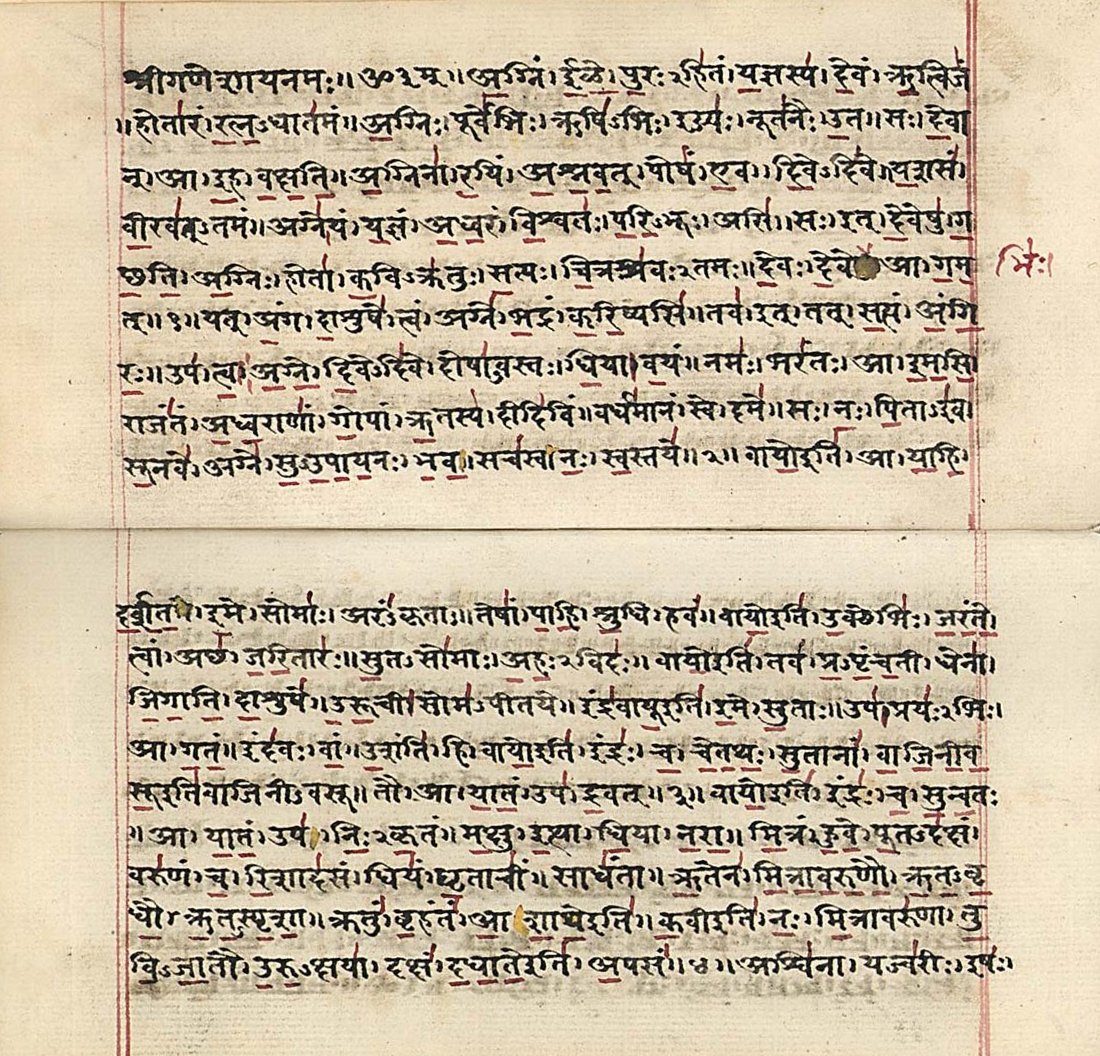
An early 19th-century manuscript of Rigveda (padapatha) in Devanagari.
History books in India try to ignore the dominant Hindu ethos of the country and its history before the Islamic period. India’s greatest historical and cultural document, the Mahabharata and Ramayana are hardly given any attention in the schools. So too, the Vedas, Puranas, Buddhist Jatakas and other prime historical and cultural documents of the country are ignored because of their religious overtones. If they do address India as a nation, it is only India of the independence movement that they acknowledge, as if prior to 1947 India did not really exist. While Nehru is made important, older kings from the Rigvedic Bharatas to Yudishthira of the Mahabharata period to the Marathas of the eighteenth century are hardly mentioned. There is no real sense of any historical continuity to the culture, much less to the country. While Mahatma Gandhi is emphasized, the greater spiritual traditions of India and its great teachers from the Vedic rishlS, Vedantic Buddhists and Jain sages to modern savants like Sri Aurobindo and Ramana Maharshi are not given much attention.
It is true that history should not be a mere instrument of a destructive nationalism and should avoid instilling aggression against other lands and peoples, even when upholding what is valuable in a nation’s history. But this does not require that the national value of historical studies is negated altogether.
The question, therefore, is how the history accounts in India made to reflect and instill a genuine nationalism and sense of the country’s history and destiny. India, after all, is one of the great civilizations of the world, with cultural traditions that have much value for humanity. Such historical accounts must reflect the richness and diversity of Indic civilization, but they cannot ignore its unity and continuity either.
The fact is that you cannot build a nation without creating history books that instill a positive nationalism, particularly in the youth. The real danger in India is not the arising of a chauvinistic nationalism like that of Nazi Germany or Fascist Italy—which are foreign to the mentality and ethos of the country—but a lack of national spirit and historical consciousness that keeps people alienated from their roots and the country divided.

India needs a real nationalism and for this a national sense of history, pride and purpose is required. A true Indian nationalism will be rooted in an Indian ethos of dharma, spirituality and pluralism, but this does not mean there can be no national or historical pride without encouraging communalism in the country. On the contrary, a greater sense of national identity would be the best thing to counter the disintegrating influence of religious, castist and regional interests that are bringing the country down.
Therefore we must ask: Why can’t Indians connect India’s traditional ancient literature, the Vedas, with its archaeology through Harappa and the many sarasvati River sites? Why can’t Indians find national pride in their own history both on literary and archaeological levels? Why should history in India be used for national shame, rather than National pride? Why should history of India place Indic civilization out of India? These are questions that must be answered.

Western and Indic Views of History

The subject of history in the Western context is very different than in the Indian context. In the Western view, history is mainly an account of political events and economic progress, a purely outward affair. In the Hindu view, history is a means of teaching detachment, showing how great kings and kingdoms come and go in the course of time. It has an inner value as a spiritual teaching about the nature of human life and the need for liberation from worldly concerns. In the Western view, history is progressive from the crude beginnings of agriculture and village life moving forward to the present day urban culture. In the Hindu view history is cyclical, with various cultures coming and going over time as the soul seeks liberation from the phenomenal world.
The Western progressive account of history is quite flawed. For example, the first civilizations of the ancient world that we can document—including Egypt. Sumeria, India and China—did not regard themselves as the first but were aware of many cultures and kingdoms before them, particularly prior to a great flood. The civilizations that we regard as the first saw themselves as very old with many antecedents! Yet we pretend that there was nothing before them!

Mauryan building in the Barabar Mounts. Grotto of Lomas Rishi. 3rd century BCE.
In addition, the civilizations of the Third Millennium BCE, like those of Egypt and Harappan/Sarasvati India, had better urban and architectural achievements than those that followed for many centuries. Even Europe had its Dark Ages after the Roman period in which much knowledge was lost. This idea of history as linear progress is clearly not the case. While humanity has progressed scientifically, this is mainly over the past five hundred years.
On the other hand. we see a spiritual decline since ancient times and over the last century we can note a decline in culture, art, music and philosophy in Europe itself, coinciding or even caused by great advances in science.

As India is the only civilization of antiquity to survive the onslaught of time, it is the special responsibility of Indians to discover not only their own history but also that of the entire ancient world. Just as there are unquestioned distortions of ancient India, similar distortions of other ancient cultures also exist. For example, the religion of ancient Egypt, which like that of the Vedas demonstrates much occult and spiritual significance, is similarly dismissed as polytheism, idolatry or henotheism (worshipping different Gods as the supreme God), exactly like the Vedas.
Revamping the way history is taught in Indian schools would be a major step in the direction of a more authentic and spiritually sensitive history of the world. It is a scientific and spiritual imperative, not only for India but for all countries.
[Excerpted from the David Frawley’s book Hinduism and the Clash of Civilization. ]

Source: indiafacts