NaMo NaMo

Namo Event

Showing posts with label AAP Ka Sach. Show all posts

Saturday, 8 October 2016

Arvind Kejriwal: The Reckoning, Spying, splurge, nepotism and more from the secret core of the Kejriwal regime


Spying, splurge, nepotism and more from the secret core of the Kejriwal regime


SCHOLARS SUGGEST THAT the late US President Richard Nixon, he of the Watergate scandal who had at the height of the 1971 Bangladesh War described Mrs Indira Gandhi as a ‘witch’ and worse, often found it difficult to tell the profane and the sacred apart, consumed as he was by avarice for power and a pathological need to keep tabs on rivals. Faced with opposition within the White House to the use of wiretaps and break-ins to guard his political interests—which he euphemistically referred to as ‘national security concerns’—he once roared, “I mean I want it implemented on a thievery basis. Goddamn it, get in there and get those files. Blow the safe and get it.” Snooping on political opponents for a professed lofty goal would later cost him the presidency. The Watergate scandal—he had got the Democratic National Committee office in a hotel by that name bugged—forced him to resign in 1974.

Though Delhi Chief Minister Arvind Kejriwal may seem to share rather few traits with Nixon, who liked to rant, swear and slur in private and sometimes in public, many of those who work closely with him report a temperament just as high-strung and melodramatic. In his book, The Crown Prince, The Gladiator and The Hope, his Aam Aadmi Party (AAP) colleague Ashutosh recounts that under fire in 2014 from former colleagues such as Yogendra Yadav and Prashant Bhushan for his alleged engendering of a personality cult, Kejriwal became uncontrollably sentimental. ‘He started to say something, but could not complete. He broke down and as tears fell unheeded, he crumbled to the floor,’ notes Ashutosh in the book. Biographies and declassified tapes and papers on Nixon underline the high drama and emotion—for effect or otherwise— that characterised almost every moment of his. And now, documents of the Delhi government to whichOpen has gained exclusive access show that Kejriwal may resemble the tainted Republican President even more closely than meets the common eye.

As soon as the IIT-educated former RTI activist returned to power in early 2015 with a brute majority in the Delhi Assembly, it emerges that he began to put together a team that comprised serving and retired officials of the Enforcement Directorate, Police, Central Bureau of Investigation (CBI) and other agencies, and offered them secret funds, perhaps with the intent to run a body of sleuths that would work in parallel with the Anti-Corruption Bureau (ACB). Shockingly, this effort was kept under wraps and made without securing the required approval of the Lieutenant Governor of the Union Territory of Delhi.

Nixon’s fate was sealed by a smoking gun in the form of transcripts of a recorded phone call to his Chief of Staff. Such glaring evidence of impropriety may still be elusive in the case closer home, but the documents smack of malfeasance and bring to light the unseemly extent to which the Delhi government went to install a Nixonian secret service division that would be under the control of just one man: Kejriwal.

It all started with a Delhi government cabinet decision on 1 April 2015 to strengthen the ACB by creating 259 new posts to add to the existing 116, and by bestowing greater powers on a few senior officers. The meeting also proposed raising the secret service fund from Rs 1.5 lakh to Rs 20 lakh and hiring technical experts from the accounts, income tax, engineering, legal and revenues departments. The grand plan also envisaged the procurement of 68 vehicles, 70 mobile phones with accessories, 75 computers and 22 printers, apart from other durables, besides high-end equipment for data and research analysis and surveillance and monitoring purposes.

At another cabinet meeting, held on 29 September 2015, a proposal for the creation of a new unit—a feedback division of sorts—under the Directorate of Vigilance (under which the ACB operates) was discussed and immediately approved. The new division, known only to the grandees of Delhi’s AAP government, was aimed at firming up its vigilance department. The cabinet note said: ‘A need has been felt to improve the monitoring mechanism of activities of various departments in vigilance related matters. Therefore, a unit may be created in the Directorate of Vigilance, Government of NCT of Delhi, manned by serving as well as retired personnel to gather relevant information and actionable feedback regarding the working of the departments/autonomous bodies/institutions/entities, etc, falling under the jurisdiction of Government of NCT of Delhi and also to do trap cases.’

According to officials in the know, this ‘feedback’ unit of some 20 odd people has been functional since February this year. More people, Open learns, were hired later. The chief secretary, who is also the chief vigilance officer of the government, has been kept in the dark about its functioning. The exact nature of this unit— consisting of hardnosed intelligence officers loyal to AAP—be it their performance parameters, reporting structure and so on, have not been officially defined. 

According to officials that Open spoke to, the office of Lieutenant Governor Najeeb Jung discovered the unit’s existence only as late as August. Evidently, the cabinet decision to create such a unit had not been approved— as required—by the L-G, and in the process, the ruling party has come under sharp attack by bureaucrats for reportedly eavesdropping on them and others with mala fide intentions. Arvind Kejriwal didn’t respond to queries emailed to him by Open.
Amid cries of intrigue and deviation from long-held governmental norms, the Kejriwal government also approved the setting up of a ‘creative’ unit to offer consultancy services on infrastructure and other projects for a period of two years. The members of this group were hired through a Delhi-based human resources firm, Soni Detective & Allied Services Pvt Ltd, which, ironically, has experience mostly in supplying semi-skilled and unskilled manpower to companies rather than highly skilled consultants to Delhi’s Public Works Department (PWD). Strangely, salaries for members of this team were to come from funds set aside for the ambitious third-phase of the Barapullah elevated corridor project—in flagrant violation of norms. “For a government that often hit out at the Central Government for harbouring a hidden agenda against it, the AAP dispensation has remained largely opaque in several of its activities, as these projects confirm. My complaint is that the L-G is not being aggressive enough in reining in these kind of activities. The Centre also should investigate this,” says a senior Delhi government official asking not to be named for fear of being victimised.

Transparency in governance, the fight against corruption and the interests of the common man have been the three vital parts of AAP’s poll manifestos. In Delhi, the party won two Assembly elections in less than two years, the second victory being one of India’s most resounding ever. The party was voted to power by people who were roused by Kejriwal’s pro-poor image and call to overthrow a political system dominated by the Congress and BJP. The AAP also made possible a near impossibility in traditional Indian politics: it drastically lowered old entry barriers to parliamentary politics that had been raised over the decades by parties that tended to handpick poll contestants either from prominent families or party cadres. There was a time that pundits would compare the BJP-Congress dominated political field to Bollywood, where actors from non-film families rarely make it big.

The new party, created by Kejriwal and others after they snapped ties with the anti-graft Anna Hazare movement in late 2012, shot to instant fame on the promise of ushering in an entirely new political climate. It offered to make a new beginning, with politicians back to behaving like commoners instead of the dynasts that the country had got used to. Its genesis as a party of values only compounds the embarrassment it seems to have in store. The generous would put it down to the old saying that power corrupts. Others would say they suspected something rotten all along.

ALREADY, AAP’S PUBLIC image has been sullied by a raft of criminal cases against its leaders, including elected representatives, some of whom have been sacked by the Delhi government. Closer scrutiny only worsens matters for it. Documents in possession of Open confirm that AAP leaders do not always practice the austerity they so loudly preach. Take the party thrown by the Delhi government to celebrate its second anniversary at the Chief Minister’s official residence. It presented guests with an embarrassment of riches on the menu. At the twin events organised on 11 and 12 February at the Chief Minister’s home, catering arrangements were made by the Delhi Tourism and Transportation Development Corporation (DTTDC), which got Taj Palace Hotel to lay out a lavish spread. For all the Gandhian ways the party brandishes like medallions, the cost of the buffets were billed at a monstrously steep Rs 12,000 per plate. This is far in excess of the ceiling for state-borne expenses for such functions. The maximum permissible amount the government can spend is Rs 2,500 per plate for dinners hosted in five-star and other luxury hotels, with an overall ceiling of Rs 4.5 lakh per event. DTTDC was later asked to offer discounts and raise a new bill. The first bill was Rs 11.04 lakh for twin lunches. The revised bill totalled Rs 9.9 lakh.
On 6 August 2015, Dr Nikunj Aggarwal sent a handwritten letter addressed to the director of the state-run Chacha Nehru Bal Chikitsalaya (CNBC). The subject of the letter was: ‘Request for application for post of S-R orthopedics’, S-R being short for ‘senior resident’. Written lazily and with scant respect for English grammar and punctuation, the letter said: ‘With due respect I. Dr Nikunj Aggarwal DNB orthopedics requesting you to consider my request for the post of SR orthopedics in your esteem instituition. So please kindly consider my request and …. Enclosing a copy of C.V here with. Yours faithfully Dr Nikunj Aggarwal.’
The CNBC issued an appointment order four days later, though there was no vacancy for the post in the hospital. Less than a month later, on 4 September 2015, he was named Officer on Special Duty to Delhi Health Minister Satyendra Jain, who, incidentally, is also Delhi’s PWD minister. Aggarwal was appointed to the post on the request of Jain. Why should a CNBC employee under contract be made OSD to the health minister so arbitrarily when there are several other officers of the Delhi government who could fulfil the demands of the role? The answer is simple. Aggarwal is unlike any other candidate: he is the son-in-law of Kejriwal’s sister-in-law.

If Aggarwal had a privileged stint at CNBC, he fared better in the ministry. He has been granted four extensions so far. While he was a contractual employee, the health minister nominated him for a management development programme for senior healthcare officials at IIM Ahmedabad at a fee of Rs 1.15 lakh (from 20 June to 25 June), though he was not entitled to participate in such courses under the hospital’s rules. Aggarwal also accompanied a group of state officers, architects and doctors on a visit to China, prompting charges of nepotism and financial impropriety.

Meanwhile, the Delhi government also hired scores of security guards—at high salaries—in state-run hospitals, arguing that doctors have lately been vulnerable to attacks by angry relatives of patients whose lives could not be saved, among other such odd reasons. The administration didn’t follow the standard tender- floating process for such appointments. Given the opacity, critics have reason to suspect a hidden plan to accommodate party workers in such jobs.
In a striking oversight of all norms on conflict-of-interest, the three security agencies that bagged the contract—Knightwatch, Innovision and SIS India—were also the ones that were asked to carry out surveys of the requirement of security staff in select hospitals in the national capital and submit a report on the extra workforce needed. In another departure from norm, only these three agencies were called for a meeting convened by Delhi’s Health and Family Welfare Department to solicit security proposals.

The pay scales for the new guards were decided unanimously by these agencies, and this, without citing the wage proposals made by rival agencies. The trio also included a bonus of 8.33 per cent and a gratuity of 4.81 per cent of the basic minimum wage in the rates quoted, though such benefits are usually given to staff members only after at least six months of service at a state-run institution.
Delhi’s AAP government has left no stone unturned in trying to reach out to people at large through various means, especially in states where it senses prospects of power. As part of a campaign launched in July titled ‘Talk to AK’, which features interactive sessions with the Chief Minister, citizens across the country are being invited to ask Kejriwal questions over the phone, via text messages or social media platforms. It is no coincidence that this campaign comes at a time when AAP is gearing up for Assembly polls in such states as Goa, Punjab and Gujarat.

However, the public relations agency that is advising the party’s top leaders—including Kejriwal and Deputy Chief Minister Manish Sisodia—has run into trouble over violation of contractual obligations. Much to the embarrassment of the government, Perfect Relations, which was awarded a consultancy contract by Delhi’s Directorate of Information and Publicity (DIP) on the social media campaign conceived by the Chief Minister and his team, is in a tight spot for ‘using confidential information for private gains’, according to a document procured by Open. At first, the PR agency had submitted a proposal for a digital advertising campaign on Facebook, YouTube and Google Hangout. After submitting an initial proposal to DIP on 6 July 2016, Perfect Relations later revised its offer, agreeing to forgo its agency fee of 12 per cent of the Rs 1.58 crore project but instead proposing to execute the plan on its own. Officials have noted that Perfect Relations did this despite being aware of the obvious conflict-of-interest involved in appointing itself the beneficiary of its own recommendation. A document states that ‘Secretary, DIP, and Special Secretary (Finance) were sternly counselled on their overlooking this evident first principle conflict of interest in this proposal. This is deeply regretted as non-assessment of the proposal on this count may have blindsided the Honourable Deputy chief minister in agreeing to this proposal.’ The DIP has now been asked by the private secretary, finance, to put out a new call for proposal submissions to enlist a new communications consultant. Payment to Perfect Relations is now kept on hold.

Simplicity in personal life and probity in public life are the core values that AAP leaders have sworn to uphold. Most of them are of humble origin and this lent them an aura of credibility when they spoke of being aam people along the campaign trail. The trappings of power, however, seem to have put paid to all that.
Consider the criticism levelled by the opposition against Sisodia for spending time abroad while Delhi was grappling with public health scares following a fresh outbreak of vector-borne diseases such as Chikungunya. L-G Najeeb Jung reportedly summoned Sisodia last month back from Finland to manage a public health crisis with hospitals struggling to accommodate patients. Kejriwal had been away for treatment in Benguluru at the time.

The frequent foreign trips of Sisodia and Satyendra Jain have not escaped the notice of people and doubts have arisen over their need. Documents reveal that Sisodia, who was on a trip to Brazil with a four-member entourage to attend a conference from 11 to 16 August last year, included in his itinerary Iguazu Falls in neighbouring Argentina without obtaining the approvals required by protocol. This led to the state incurring an additional cost of more than Rs 29 lakh, including transfer charges. The paper trail of Sisodia’s Brazil trip shows that the minister flouted Delhi’s prevailing austerity measures even before he departed by including non-specialists (and only one academic) in his contingent. He also opted to travel business class on KLM instead of Air India.

IN SEPTEMBER 2015, Sisodia visited Australia and New Zealand, again travelling business class on Singapore Airlines instead of Air India. Delhi’s Deputy Chief Minister also went on tour to London from 17 March to 20 March this year. This was to participate in a one-day conference to which he was invited by the student union of London School of Economics. He travelled with his secretary on government expense. “The fact is none of these trips are essentially official and are of no particular use to the people of Delhi. They are as good as personal trips,” says a senior Delhi government official who asks not to be named because he is not authorised to speak to the media.

From 30 May to 3 June this year, Sisodia visited Berlin to attend the German Habitat Forum. Documents say that no mandatory cadre clearances were obtained for the two officers who accompanied him on the trip. Besides, these visits were made without the required permission of the Lieutenant Governor.
Satyendra Jain has proven an avid globe-trotter as well. From 12-15 March 2016, he was on a trip to Malaysia to ‘study’ a rapid transport corridor (BRT Sunway Line) in that country along with a five-member team. He flew business class. Asked to reduce the size of his delegation by the Centre, he chose to drop a subject expert.

Jain also went on a ‘study visit’ to Stockholm from 25-29 October on a casual invitation made by the Swedish envoy to New Delhi. The 11-member delegation included an attendant of Delhi’s Transport Minister Gopal Rai. Both the ministers travelled first class. Jain and some others also undertook a ‘study’ visit to the UK without technical experts. Open contacted the office of the L-G for comments, unsuccessfully.

Admittedly, the amounts appropriated by AAP ministers and their hangers-on are minuscule compared with what has come to light in corruption scandals involving other political parties. But as the second official says, “It is usual for political leaders to travel abroad whenever there is an opportunity. However, these are leaders who have come to power hardselling Gandhian values over the excesses of others. That these people are also easily being co-opted by the system is unfortunate.”

Kejriwal would do well to remember the late US President John Adams’ dictum on the corrosive effects of being in authority: since power corrupts, society’s demands for moral authority and character increase as the importance of the position increases. Richard Nixon discovered this too late.

Source: openthemagazine

Sunday, 24 August 2014

Exclusive: A propaganda war by Maoists and Arvind Kejriwal’s half truths

AAP convener Arvind Kejriwal during a press conference in New Delhi on Friday. PTI
AAP convener Arvind Kejriwal during a press conference in New Delhi on Friday. PTINew Delhi, Aug 22: Even as the removal of Sanjiv Chaturvedi, an Indian Forest Service Officer of 2002 batch with a controversial past, from the post of Chief Vigilance Officer of All India Institute of Medical Sciences kicked off a controversy resulting in an attempt by a fledgling Aam Aadmi Party to jump on the bandwagon with Arvind Kejriwal holding a press conference in the Capital over the issue, there are several interesting details which are emerging that indicate that it has become a ‘propaganda war’ fuelled by the Maoist sympathisers.

According to sources, a doctor who is known to be a close sympathiser of the Maoist outfits and is currently posted in AIIMS, has played an important role in chalking out the ‘media strategy’ which portrayed Chaturvedi as a crusader in certain sections of media after order of his removal from the post of CVO came. The said doctor is known to be well networked in the media and appears to be playing an important role in the ongoing episode where attempts to drag names of certain BJP leaders are more than obvious.

It is interesting to note that in the past allegations have also been levelled against AAP for its proximity to Maoists with several Maoist sympathisers already in its ranks. It may not be coincidence that AAP chief Arvind Kejriwal held a press conference on this issue in the Capital on Friday afternoon. The indications are that this could all be a part of the ‘propaganda war’ .

Meanwhile it is interesting to note that the officer at the centre of the current controversy had a controversial past. As a probationer in the Indira Gandhi National Forest Academy at Dehradun Chaturvedi was served with several show cause notices for indiscipline and misconduct during 2003-04.

During the year 2004, Rakesh Jagania, a fellow probationer from the scheduled caste community alleged that Chaturvedi abused and assaulted him. The district magistrate of Dehradun ordered the Academy to conduct an enquiry which found him guilty of assault.

During the year 2009, when Chaturvedi went for a training course to IIM Ahemdabad, he indulged in gross indiscipline on account of which he was denied the certificate of participation. The Academy authorities also brought this to the notice of the Chief Secretary Govt. of Haryana.

In 2011, Chaturvedi’s wife and father-in-law levelled allegations of demand for dowry and mental torture and sent a complaint to then Director of the IG National Forest Academy Dehradun. No action was initiated on the complaint but Chaturvedi’s marriage ended after sometime with a divorce.


Interestingly, Kejriwal didn’t mention the controversial past of the said officer in whose favour he held a press conference. Sources in the government said that the media outcry on removal of Chaturvedi came as a surprise even as names of BJP leaders and the Minister for Health and Family Welfare were being dragged in the controversy. Sources further added that so far the indications are that the government would not take back its decision to remove Chaturvedi.

Source: http://www.newsroompost.com/exclusive-propaganda-war-maoists-arvind-kejriwals-half-truths/

Saturday, 7 June 2014

Experts deflate Arvind Kejriwal’s logic to lower gas prices

Pranav Nambiar | New Delhi | Updated: Feb 15 2014, 01:45 IST

Not just Canadian explorer Niko Resources, which sells gas from its onshore fields in Bangladesh at $2.34 per million metric British thermal units (mmBtu), even India's very own ONGC has cost of production across blocks at $3.7/mmBtu.

However, contrary to what the Delhi government believes, that doesn't build a case for putting on hold the implementation of the Rangarajan panel's proposal to align the price of gas in India with chosen global benchmarks, which means doubling the price from the present $4/mmBtu effective April 2014.
Gas prices are a function of production-sharing contract (PSC) norms that have legal sanctity and demand-supply dynamics.

The gas from Bangladesh available at $2.34/mmBtu is produced from onshore fields west of Dhaka that have a significantly lower cost of production compared with deepwater blocks like the KG-D6 fields (where Reliance Industries and Niko are partners). Former ONGC chairman RS Sharma said that cost of production of gas varies from country to country and, therefore, drawing comparisons with Bangladesh is pointless. In the case of Saudi Arabia, he noted, gas production costs as low as $1/mmBtu and around $2/mmBtu in the US.

Sharma said Delhi CM's demand to lower gas prices violates the sanctity of the PSC, which calls for an arm's-length pricing with the approval of the government. “The reputation of India amongst foreign investors would be at stake (if the price hike plan is abandoned),” he said.

The various types of gas resources available in India, including onshore,offshore shallow, offshore deep and offshore ultra deep, have distinct commercial thresholds.

A report by consultancy firm IHS-Cera notes that only a very limited amount of deepwater finds in India are economic even at $8/mmBtu. A price of $10/mmBtu and above is required to develop most of the deep water, ultra- deepwater and technically challenging shallow water finds.

The report adds that at the domestic price of $8/mmBtu, India will be importing about 68% of gas while at around $12/mmBtu the import dependence will come down to around 24%, a huge boost for the energy sector where the gap between demand and supply is constantly increasing.


A senior ONGC official told FE that rather than having one price tag for gas produced from all the blocks, a differential pricing mechanism will be more feasible. "The $8/mmBtu price is good for deepwater blocks, but anything less than $5.85-$6/mmBtu is not viable for shallow water blocks. However, $4.2 is a good enough price for onshore blocks," he said.

Sunjoy Joshi, director of the Observer Research Foundation, feels that it would be ideal to allow market forces to determine prices. "Since it takes at least five years after discovery to start production, fixing prices well ahead of time is counterproductive in a dynamic sector.”

Analysts say that if India has to encourage more investments in exploration activity and secure its energy security, it is vital to raise prices above the $4.2/mmBtu level.

With dwindling production in India, the country has now become increasingly reliant on gas imports and is expected to become a net importer soon. The cheapest international source of gas that sells at $2-$3/mmBtu in the local US markets will end up at a landed cost of at least $11-12 in India, higher than what the

Rangarajan panel has recommended. Spot and short-term LNG prices hover in the $18-19/mmBtu range.
Experts say that there are enough buyers at higher prices from a range of sectors including steel, LPG, auto components, glass and petrochemicals.

Source: http://www.financialexpress.com/news/experts-deflate-arvind-kejriwal-s-logic-to-lower-gas-prices/1226240/1

Friday, 2 May 2014

Ford Foundation’s link with Congress, NAC, AAP


Surajit Dasgupta

The correspondent is a journalist who has worked with The Statesman, The Pioneer and Money Life besides freelancing for some other newspapers and magazines. He was a founding member of the Aam Aadmi Party who resigned from the organisation in November 2013, protesting lack of internal democracy, selection of quite a few candidates of dubious credentials, and a populist manifesto that he thought would wreck Delhi's economy.

In our reports, ‘AAP part of international anti-India racket’ part 1 and part 2’, we revealed the Ford Foundation connection of the following Indian NGOs:

• Sampoorn Parivartan (later christened Parivartan) of Arvind Kejriwal and Kabir of both Kejriwal and Manish Sisodia.

• ICSSR of Jawaharlal Nehru University that funded Yogendra Yadav.

• PRADAN of Meera Sanyal.

There are other Leftist noise makers who are beneficiaries of the Ford Foundation:

• Mallika Sarabhai’s NGO Darpana.

• Amartya Sen for his book, The Idea of Justice.

• Teesta Setalvad and Javed Anand’s Sabrang Communication.

These names have also been mentioned by R Vaidyanathan of the Indian Institute of Management, Bengaluru, in his investigative article ‘Is India safe: What is Ford Foundation?’

While the first four dramatis personae are members as well as election candidates of the Aam Aadmi Party (AAP), the next four are sympathisers of the party. Sarabhai had actually got into the party but was then repelled by the only apparent right winger in the fold, Kumar Vishwas.

Arvind Kejriwal’s Ford Foundation agenda

Activists in Gujarat allege that Sarabhai runs an ‘empire of trusts’ in the State, and whenever activists and reformists demand that the State must switch from income tax gradually to wealth tax, she is among the foremost to oppose the proposal. Ambalal Sarabhai was given licenses by the British Empire to run textile industries. His granddaughter Mallika Sarabhai is a trustee in several trusts that own miles and miles of plots of land across Ahmedabad. Her land holdings are official and known to the Government, but the data are not made public as details of a trust’s wealth are permitted to stay confidential by law. She fears a new Government promising systemic changes may change this law and make her look super rich, rather awkwardly. She runs NGOs that used to supply goods to various Government departments at premium prices. The reason that turned her against Chief Minister Narendra Modi is his policy to have variety in vendors from whom the Government buys goods required by the State, alleged Sarabhai’s former colleagues under the condition of anonymity.

The book, Toward Sustainable Development: Struggling Over India’s Narmada River, edited by William F Fisher, shows special interest of these American outfits in Medha Patkar’s Narmada Bachao Andolan: Ford Foundation, Rockefeller Foundation, Indo-US Sub-Commission on Education and Culture and the US Department of Education. Patkar is also the AAP’s Lok Sabha candidate from Mumbai northeast.

“If you have so much of evidence, then why don’t you complain to the Government?” my detractors often ask. Complain to which Government, the one that grants Sisodia permission to receive foreign funds in 2005, before his NGO is registered in 2007!

There is another reason to suspect a CIA-Indian National Congress nexus. On December 3, 2013, The Economic Times reported that the Unique Identification Authority of India (UIDAI) had contracted MongoDB — an American open source, cross-platform, document-oriented, database system start-up — in an unspecified database management capacity. MongoDB is partially funded by the not-for-profit venture capital firm of the CIA called In-Q-Tel (IQT). In-Q-Tel works with National Geospatial-Intelligence Agency, Defence Intelligence Agency and Department of Homeland Security Science and Technology Directorate, too. Making the deal more suspicious, neither UIDAI nor MongoDB or UIDAI Chairman Nandan Nilekani responded to queries from ET on whether the CIA link was considered before entering into a partnership.

AAP an international conspiracy against India

Out of the declared beneficiaries of the Ford Foundation, one would note that almost all NGOs have some Government, National Advisory Council (NAC) or AAP connection:

To promote ‘transparent, effective and accountable Government’

For research and public policy analysis:

• Centre for Budget and Governance Accountability (CBGA) — $325,000

• Samarthan Centre for Development Support (SCDS) — $150,000

• Association for Democratic Reforms (ADR) — $200,000

• Prayas — $350,000

• Centre for Policy Research (CPR) — $200,000

For programmer exploration:

• Praja Foundation

To strengthen ‘human rights worldwide’

For research and public policy analysis:

• SAATH Charitable Trust – $200,000

• Vigyan Foundation – $200,000

• Natural Justice – $250,000

• National Academy of Legal Studies and Research University – $330,000

• Rural Development Institute – $315,000

• Centre for Economic and Social Studies – $200,000

For capacity building and technical assistance:

• IDEAL: Institute for Development Education and Learning: $270,000

• South Asians for Human Rights (SAHR): $200,000

For advocacy, litigation and reform:

• Lawyers Collective: $1240000

‘Expanding livelihood opportunities for poor households’

For programme exploration:

• Centre for Collective Development (CCD): $300,000

• Madhyam Foundation: $250,000

• Neeti Solutions Private Limited: $250,000

• Action for Social Advancement (ASA): $550,000

Programme demonstration and scaling:

• Friends of WWB – India (FWWB): $500,000

• Access Livelihoods Consulting India Pvt Ltd – $190275

• Sarba Shanti Ayog (SSA) – $250000

• Rabobank Foundation – $690000

Advocacy, litigation and reform:

• Trickle Up Program, Inc – $350000

• Professional Assistance for Development Action – $590021

• Xavier Institute of Management – $500000

• United Nations Development Programme (UNDP) – $370000

• Institute for Financial Management and Research – $250000

• The Livelihood School – $350000

Research and public policy analysis:

• Foundation-Administered Project (FAP) – $342000

“Expanding community rights over natural resources” (this agenda figured prominently in the first policy meeting of the AAP held in the house of Shalini Gupta, Prashant Bhushan’s sister, in Noida in between January 11-13, 2013. Yogendra Yadav, Anand Kumar and invitees Prof Arun Kumar and Aseem Shrivastava stressed the need to switch socialism from bureaucratic control to community ownership)

Programme demonstration and scaling:

• Vanangana – $310000

• Arthik Anusandhan Kendra – $176250

• Stichting Hivos – $1400000

• Sahjeevan – $320000

Research and public policy analysis:

• Vikas Sahyog Kendra – $160000

• Society for Promotion of Wastelands Development (SPWD) – $210000

• Foundation for Ecological Security (FES) – $300000

• Ashoka Trust for Research in Ecology and the Environment – $200000

• Board of Trustees of the University of Illinois – $91844

Advocacy, litigation and reform:

• Centre for the Study of Developing Societies (CSDS) – $140000

• Centre for People’s Forestry (CPF) – $200000

• Vasundhara – $300000

Network building and convening:

• Samaj Pragati Sahayog (SPS) – $345656

Programme learning:

• Foundation-Administered Project (FAP) – $630000

Communications and public education:

• Sahjeevan – $80000

“Advancing media rights and access”

Research and public policy analysis:

• LIRNEasia – $300000

• Vikas Samvad Samiti – $200000

• Jamia Millia Islamia – $200000

• Centre for Communication and Development Studies – $250000

Evaluation and assessment:

• Indian Institute of Management, Ahmedabad: $150,000

Capacity building and technical assistance:

• Rural Broadband Pvt Ltd: $350,000

• Indian Institute of Technology Bombay: $530,000

• Society for Development Alternatives: $250,000

• Urban Design Research Institute: $200,000

Stakeholder development and collaboration:

• One World International Foundation: $257,450

“Youth sexuality, reproductive health and rights”

Capacity building and technical assistance:

• Institute of Social Studies Trust: $200,000

• Nirantar: $250,000

• SAMA – Resource Group for Women and Health: $240,000

• Health Institute for Mother and Child – MAMTA: $280,000

• CREA: $440,000

• Sahaj: $200,000

Programme demonstration and scaling:

• Women Power Connect: $250,000

• Asmita Resource Center for Women: $275,000

• HAQ: Centre for Child Rights: $235,000

• Sakhi: $200,000

• Centre for Development and Population Activities (CEDPA): $477,500

• Society for Nutrition, Education and Health Action: $190,000

• Sahayog Society for Participatory Rural Development (SSPRD): $340,000

• Anusandhan Trust: $300,000

• Health Institute for Mother and Child – MAMTA: $335,000

Advocacy, litigation and reform:

• National Foundation for India: $690,000

• Center for Reproductive Rights: $300,000

• South Asia Women’s Fund: $175,000

Communications and public education:

• Centre for Media and Alternative Communication: $200,000

In a report, ‘Can AAP fill political vacuum?’, the reporter quotes the CBGA’s Manzoor Ali who approves of the AAP but urges it to retain only its Leftist leadership while weeding out its right-wing supporters. The CBGA’s treasurer Anil K Singh is also the secretary general of South Asian Network for Social and Agricultural Development (SANSAD) whose links with the international anti-India racket has been talked about in my previous article.

Bhopal-based Yogesh Kumar of the SCDS is also a part of the CBGA.

The ADR finds only 14 per cent of the AAP candidates (up to the seventh phase of the Lok Sabha elections 2014) with criminal charges while full-time activists of the party allege they number in hundreds. Of course, the ADR does not count in its total AAP candidates perceived as anti-nationals by the party workers. More about the ADR finds mention later in this exposition.

AAP part of international anti-India racket: Part 1

Rajmohan Gandhi, whose links with Ghulam Nabi Fai has been disclosed in my previous article, has worked for the CPR. And going against the advice of all administrative experts and economists who rubbished the AAP Government’s free water programme, the CPR vehemently supported it through its policy document, “In defence of free water — beyond the Delhi experiment,” calling it “momentous”, going to the extent of equating Delhi with South Africa. Those who have keenly followed the election speeches of Kejriwal throughout 2013 know that he kept saying, “If water can be distributed free in South Africa, it can be in Delhi as well.” Now you know who gave him the idea. Gandhi has also worked with the University of Illinois, whose board of trustees is another Ford Foundation beneficiary.

Never mind the fact that the South African model is not Government-intensive. It comes with management contract to private operators and is equipped with pre-paid meters. It also stresses on universal access to basic sanitation. And the Central Government’s intervention was phased out following the second white paper released in 2002 on the issue.

Praja’s managing trustee Nitai Mehta says, “(The) AAP has brought good governance to the fore and shown that politicians cannot take the common man lightly,” in an interview to The Times of India. To the same newspaper in another interview, Mehta promotes the AAP’s Mumbai northeast candidate Medha Patkar, “She will make a huge dent in (the NCP’s Sanjay Dina) Patil’s vote bank in the slum areas, where she has championed the cause of the poor.”

The SAHR’s Kamla Bhasin wrote about the AAP in Hindustan Times on January 12: “I am happy that the party did well at the hustings.” However, she was displeased with Kejriwal’s phraseology. She nit-picked thus: “… every sentence he uttered was in the masculine gender.”

John Dayal is a member of this NGO. I have mentioned where he fits into the international anti-India racket in my previous article.

Lawyers Collective’s Indira Jaising, also an additional solicitor general, famously preached something and practiced quite the opposite. In the book, Cause Lawyering: Political Commitments and Professional Responsibilities, edited by Austin Sarat William Nelson, she is quoted as saying, “The main reason why we don’t believe in accepting foreign funding is because we think that groups that do that often end up developing a vested interest in being professionals rather than servicing the community, and they get very alienated from the community for whom they work.” Outlook reported in its September 19, 2011 issue that she had received $1240000 from the Ford Foundation.

AAP part of international anti-India racket: Part 2

Hivos is a recipient of the Ford Foundation’s generous grants. Stichting Hivos, the Netherlands, is also a donor who maintains a full-fledged country office in India, receiving $1.2 million. Hivos happens to be one of the co-financing agencies to the Government of the Netherlands, whose embassy funds Kejriwal and Sisodia’s Kabir.

Hivos co-funds one of the NGOs in our list above — the CCD. It also supports, financially, one of the two Ford Foundation-funded NGOs of IIM Bangalore’s Dean Trilochan Shastri, who also runs ADR. He has also been conferred Breton Woods Committee membership, thanks to the Ford Foundation’s lobbying.

AAP’s Yogendra Yadav has been associated not only with the ICSSR but also with CSDS –both recipients of the Ford Foundation’s grants. Yadav was once a political adviser to Rahul Gandhi too.

SPS’s co-founder Mihir Shah is an NAC member. The ASA, an NGO based at Bhopal, is headed by Ashis Mondal, another NAC member.

The SSPRD is supported by the AID, which we reported to have raised funds for both the IAC and AAP in our previous article, a part of the anti-Indian leftist racket with international reach.

The acronym for Professional Assistance for Development Action is not PADA but PRADAN. That is the AAP’s Mumbai South candidate Meera Sanyal’s NGO working with the Maoists.

Deep Joshi, who conceived the idea of setting up PRADAN, is an NAC member.

Viren Lobo, executive director of the SPWD, is a big-time proponent of the AAP’s free water scheme. His Citizens’ Solidarity — Forum for Water and Sanitation (CS-FWS) passed a resolution last month seeking continuation of the fallen AAP Government’s water agenda.

What CIA seeks to achieve through Ford Foundation

Some of these NGOs also have Government connections. Every office bearer of the FES, for example, is or has been a Government servant: Amrita Patel, Samar Singh, Nitin Desai, AN Yellappa Reddy, Deepak Tikku, Mahendra Vyas, Sudarshan Iyengar and Usha Thorat. Their curricula vitae contain mention of so many Government posts they held that it would make a separate article. Readers may refer to the FES board of Governors enlisted in its website.

Same is the story of the CPF. Its managing trustee Urmila Pingle was a member of the National Tiger Conservation Authority. Kameswara Rao, a trustee, has held positions in Ministry of Environment and Forests and the Andhra Pradesh State Pollution Control Board.

Not featuring in the list above is the Self-Employed Women’s Association (SEWA). Its CEO Ela R Bhatt was honored by the Ford Foundation on May 4, 2011. The NAC’s Mirai Chatterjee comes from the SEWA. She joined the NGO in 1984 and succeeded Bhatt as its general secretary.

Is such overwhelming presence of the Government, NAC and AAP functionaries among the beneficiaries of the Ford Foundation a mere coincidence?

Friday, 18 April 2014

AAP part of international anti-India racket: Part 1

By Surajit Dasgupta on Apr 18, 2014


AAP part of international anti-India racket: Part 1

To begin with, some political commentators had speculated that one or more larger players must be behind the inexplicable projection of India against Corruption (IAC) and its offshoot, the Aam Aadmi Party (AAP), in the media and political scene. Then, India News broadcast a story of an American student Shimrit Lee who had met Manish Sisodia before the Jan Lokpal movement was launched. It was found that Egypt had erupted after her visit to that country too. Third, Ashwini Upadhyay, former head of the AAP’s legal cell, who has known Arvind Kejriwal and Manish Sisodia since the inception of their NGOs, revolted on the ground that the party had links with the US’s Central Intelligence Agency (CIA). Then journalist-researcher Madhu Kishwar exposed links of Rajmohan Gandhi, the AAP’s paratrooped candidate from the East Delhi Lok Sabha constituency, with terrorists.

Finally a larger network of miscreants, Maoists, Marxists, evangelists, tablighis, terrorists, India bashers and financiers of disruptive activities in this country helping the AAP has surfaced.

To understand how the entire international network works, the personnel connecting one nefarious organisation to another must be studied.

On July 19, 2011, two people of Pakistani origin were arrested in Washington DC. The US Department of Justice records describe one of them, Ghulam Nabi Fai, as an agent of Pakistan’s Inter-Services Intelligence (ISI). The New York Times reported that Fai was coordinating between the activities of several ultra-communist groups, Islamist outfits and Christian missionaries in India.

Fai once worked closely with Rajmohan Gandhi, the AAP’s paratrooped candidate from the East Delhi Lok Sabha constituency. Gandhi was one of the prominent signatories to the petition by 53 odd well-networked ‘liberals’ like Ved Bhasin and Gautam Navlakha that defended Fai and demanded his release from the American jail. People already know where sympathies of elements like Bhasin and Navlakha lie.

Kishwar recorded an interview with Sai Lal Jediya, son of a Gandhian freedom fighter late Hira Lal who lived in Panchgani where the headquarters of the AAP candidate’s Moral Re-Armament (MRA), now called Initiatives of Change, are located. The MRA has long been suspected of being a front of the CIA.

Madhu Kishwar writes in her website, “Sai Lal has documentary evidence to back up his charges…” She adds Gandhi instigated Hira Lal to foment separatist movements in Nagaland and other border areas of the Northeast. Sai Lal alleges that the MRA headquarters in Panchgani, Maharashtra, are centres of CIA-backed anti-national activities in India, including holding training camps for terrorist groups.

Niti Central now goes beyond the revelations above to unearth more skeletons in the AAP closet.
Fai sought the help of a US resident, anthropologist-activist Angana P Chatterji, who supports the cause of Kashmir’s separation from India, to further his agenda. The California Institute of Integral Studies (CIIS) suspended Chatterji along with her husband Richard Shapiro in July 2011 and dismissed them in December 2011, after it received complaints from students against them. The CIIS Faculty Hearing Board found them guilty of failure to perform academic duties and violation of professional ethics. Shapiro has been declared persona non grata in India for his separatist activities.

Ironically, before Chatterji was expelled, US-based advocacy group Indian Muslim Council (IMC) had given her the Tipu Sultan Award in 2008, and the CIIS celebrated the felicitation. What kind of a profile should one have to get this award? Readers will find mention of two more recipients of this prize in this report later on, from where they may draw their conclusion.

Chatterji happens to be a co-author of the book, Kashmir: The Case for Freedom, whose other authors are Arundhati Roy, Pankaj Mishra, Hilal Bhatt and Tariq Ali.

Fai, Chatterji and Roy are associated with at least one or more of three anti-Indian organisations: The ISI, Indian-American Muslim Council (IAMC) and Progressive South Asians (PROXSA).

The IAMC website gives the notorious Students Islamic Movement of India (SIMI) a clean chit and projects India as a dangerous place for minorities to live in. The IAMC supports Harsh Mander, who is now a prominent AAP member. It also hosts Harsh Dobhal, managing editor of Combat Law, a Maoist magazine, and secretary of the Independent People’s Tribunal (IPT) that damned India through its “Report of Independent People’s Tribunal on Human Rights Violations in Kashmir” published in 2010. The IPT report was published by the Human Rights Law Network (HRLN) that projects Hindus as a horrible majority population in India that persecutes Muslims, Dalits and Christians.

The HRLN’s agenda is furthered internationally by Germany-based Evangelischer Entwicklungsdienst (EED), Britain-based Christian Aid, Denmark-headquartered DanChurchAid and India-based Church Auxiliary for Social Action (CASA) among other forces that sees India divided along Hindu-Christian lines.
The IAMC often hosts India haters like John Prabhudoss alias PD John, Lise McKean and Raju Rajagopal. PD John or John Prabhudoss is the executive director of the Policy Institute for Religion and State (PIFRAS).

In the 2002 PIFRAS symposium on South Asia, Prabhudoss had, in his opening remarks, compared the conflicts in India to those of the Middle East, Sierra Leone, Central Africa, Kosovo, Chechnya and East Timor, thus equating India with some of the most cruel and violent regions in the world.

Rajiv Malhotra and Aravindan Neelakandan documented Lise McKean’s hatred towards Hindus and India in their book, Breaking India. “Whenever there is unrest in India, she shows up as a commentator to educate American audiences about what is wrong with Indian culture,” they write.

Raju Rajagopal is the president of self-styled Coalition against Communalism. His Hindu-hating articles used to be hosted by the EKTA website, known for promoting subversive elements in the country, till it was active. The trio works with Jesuit priest Cedric Prakash who finds Hindus tormentors of Christians. Rajagopal was the recipient of IAMC’s Bahadur Shah Zafar Award for “promoting pluralism and communal harmony in India” in 2008.

The PROXSA is an umbrella organisation for 300 extremist Leftists who are members of more than 20 outfits sporting different fancy names. The most prominent of these outfits are the Alliance for a Secular and Democratic South Asia (ASDSA), Alliance for South Asians Taking Action (ASATA), ASHA for Education, Association of South Asian Progressives (ASAP), Coalition for a Secular and Democratic India (CSDI), Campaign to Stop Funding Hate (CSFH), Centre for Study and Research in South Asia (CERAS), Coalition against Communalism (CaC), EKTA, Forum of Inquilabi Leftists (FOIL, earlier called Federation of Indian Leftists), Foundation for Pluralism (FfP), Friends of South Asia (FOSA), Indian Progressive Study Group of Los Angeles (IPSG-LA), NRIS for Secular and Harmonious India (NRI-SAHI), International South Asia Forum (INSAF), Organising Youth (OY), South Asian Collective (SAC), South Asian Magazine for Action and Reflection (SAMAR), South Asian Network for Secularism and Democracy (SANSAD), South Asian Progressive Action Collective (SAPAC), Supporters of Human Rights in India (SHRI), Voices for Freedom (VfF), Youth Solidarity Summer (YSS) and the Association for India’s Development (AID).


After the collapse of Maoism in India, some elements of the Communist Party of India (Marxist–Leninist) [CPI(ML)] moved to the US and, after a sabbatical, tried to revive the movement in this country, handling it from their American bases. Out of the outfits named above, the FOIL and AID were floated by these people.

The FOIL describes itself as a “clearinghouse for radical Indian activists in the United States, Canada and England”. Its purpose is described by its founders as “some place for us to share information, offer support, and encourage each other to write in the open media on issues pertaining to Indians overseas and India itself, and help build projects that make our radical politics more material”. Two of the FOIL’s co-founders are American Marxist-yet-evangelist Biju Mathew and Marxist historian Vijay Prashad. These are the people behind the propaganda in 2002 that the riots that took place in Gujarat that year were funded by Hindutva groups in America. Prashad happens to be a supporter of the now-failed Arab Revolution. He says Hinduism in its present form is nothing but a mix of Fascism and racism, and that the Bharatiya Janata Party (BJP) is personification of such ideology and, therefore, it must be condemned.

Three years before Chatterji, Mathew had received the Tipu Sultan Award for “courageously serving India and India’s interests” from the IMC.

The AID is the other prominent outfit under the PROXSA. It facilitates funding to various leftist extremist outfits by showing the financiers legally valid ways of routing the money. On different pages of the AID website, one finds campaign material for Binayak Sen and Kopa Kunjam, criticism of Salwa Judum, critique of Operation Green Hunt, Land Acquisition Act, Chhattisgarh administration and police etc.

The AID also collects funds for the AAP. On September 20, 2011, The Times of India had reported that “Arvind Kejriwal’s NGO Parivartan was supported by AID in 2008 to pursue the RTI campaign”. A page on the AID website shows it was, in 2011, soliciting money for IAC as well. Another page on the website hosts an article by Prashant Bhushan criticising the Government’s version of the then Lokpal Bill.
In quite a few other pages of the website, Arvind Kejriwal has been described as “AID Saathi”, including one where the outfit is seen soliciting donations for the AAP. Further, AID sent its volunteers to the AAP to help the party in its campaign for the Delhi Assembly elections.


AID co-hosted an event with the radical Council on American Islamic Relations (CAIR). Communications director and civil rights coordinator of the CAIR, Randall Ismail Royer was arrested and convicted for conspiring with Lashkar-e-Tayyeba to execute terror strikes in India. Royer had earlier pleaded guilty to charges of using and discharging a firearm during — and in relation to — a crime
of violence; and with carrying an explosive during commission of a felony. A decade before that, he had joined the Bosnian Forces fighting Serbs in 1994.

Royer was the third person with ties to CAIR’s leadership who has either been convicted, or is under suspicion of aiding militant Islam. Several other CAIR officials have either proven or suspected ties to militant Islam. Bassem K Khafagi has pleaded guilty to charges of visa and bank fraud in federal court in Detroit. Charges were brought against Khafagi for his role with the Islamic Assembly of North America. Khafagi was community affairs director for CAIR at the time of his arrest. On February 2, 1995, Siraj Wahhaj was named as one of the “unindicted persons who may be alleged as co-conspirators” in the attempt to blow up targets in New York. Wahhaj, on CAIR’s advisory board, was described by CAIR as “one of the most respected Muslim leaders in America.”

The most paradoxical ideology of the CAIR involves helping Leftist extremists in India but promoting Islam in the US, which it wants to turn into the world headquarters of Islamic movements in this century.

Shockingly, a member of this sinister circle is Sugata Bose, grandnephew of Subhas Chandra Bose, whose acceptance of Government of India’s version of Netaji’s death was proved ill-informed or politically motivated (or both) last year by author Anuj Dhar through the book, “India’s Biggest Cover-Up.”

Bose had co-authored a book, “Modern South Asia: History, Culture and Political Economy’, with Ayesha Jalal, a Pakistani-origin professor of history at the Tufts University in 1998. The book glorified Mughal bigot Aurangzeb as the best ruler India had ever had. Bose, Jalal and Chatterji (associate of Fai and Roy mentioned early in this report) have together, on numerous occasions, issued statements that reflect the Pakistani point of view on Kashmir.


Now we come to another wing of this international mafia. In 1999, Teesta Setalvad and her husband Javed Anand’s magazines Sabrang and Communalism Combat had, through their channels in the Indian National Congress, Communist Party of India (CPI) and Communist Party of India (Marxist) [CPI(M)], extracted $15 million to project the BJP as an anti-minority, anti-woman party. Recently, the couple accepted that they had diverted part of the fund for their NGO for personal use. Some of their witnesses in the cases related to the riots in Gujarat in 2002 have turned hostile and accused the couple of putting words in their mouths via signatures and thumb impressions on affidavits submitted to the court, whose contents were dictated at will by Setalvad.

Finally, let’s see how all these people and their shady organisations are connected to each other. In 2000, Australia-based International Council of Evangelical Churches had instituted the International Award for Religious Harmony in the memory of slain Graham Staines. This award was first given to All India Christian Council’s general secretary John Dayal, known for his Dalit-Christian persecution complex and association with the infamous Dalit Freedom Network.

In 2003, the award went jointly to Setalvad and Admiral Laxminarayan Ramdass. The latter went on to become the AAP’s internal lokpal while almost his whole family was posted in the party’s policy committees.
Kaleem Khwaja of the Association of Indian Muslims in America, infamous for his article, “Brother, can you spare a tear for Taliban,” published by the Milli Gazette, is another recipient of IMC’s Tipu Sultan Award.
We will now see how the AAP is linked with this international racket. Kejriwal received the Ramon Magsaysay Award after he was promoted by National Advisory Council’s Aruna Roy following citation of his work by the World Bank. Documents of the CIA show its links with the Ford Foundation, Rockefeller Foundation and the Ramon Magsaysay Foundation. The papers show how these foundations financially support intellectuals, students and activists across the world through mutual coordination. Our focus is on the AAP.


The World Bank featured the insignificant work of Parivartan in their report, “Social Accountability Stocktaking Exercise for South and East Asia” [World Bank Institute, Washington DC, 2005, pages 30-32]. Kejriwal was selected for the Ramon Magsaysay Award only after featuring in the World Bank report above. Narayana Murthy, the Infosys chief, is a Trustee of the Ford Foundation. He apparently advocated Kejriwal’s case for the award, as did Aruna Roy.

The CIA’s unusual interest in the AAP is evident in the fact that in 2012, right after the party was registered by the Election Commission of India, the American spy agency released a list of “significant” parties in this country. Every party that featured in the list except the AAP was a recognised party — one that has participated in elections in at least four States of the country and secured 6 per cent of the total votes polled. This, when the AAP was just one month old with no record of participation in elections!

A few years before that, a New York University researcher Shimrit Lee visited Manish Sisodia’s NGO Kabir and prepared a report, “Public Power: India and Other Democracies” (2010). She assisted in Kabir’s campaign for the Right to Information (RTI) and Local Self-Rule. She went on to work actively in Egypt. Is it mere coincidence that, while the IAC launched the Jan Lokpal Movement in India after she left, when she went to Egypt and left that country, it witnessed the Tahrir Square uprising? The Union Home Ministry has no record of Kabir having sought its clearance to host a suspicious researcher who has been active in some countries of the Middle East and Chad in Africa, required as per law of the land.

The Union Home Ministry does not come across as clean in this whole deal either. While Kabir was registered in 2007, Sisodia had got the ministry’s clearance to receive foreign funds in 2005! This is evident from the official papers Upadhyay has unearthed and handed over to this correspondent.

Did the Home Ministry bend the rules for Kabir at the behest of the Congress? If not, what was Kejriwal doing with Sonia Gandhi acolyte Ashish Talwar in Germany in 2005, Upadhyay questions. And why is Talwar now the head of the AAP’s Delhi unit?

The World Bank had committed a similar fishy act in 2002. It funded Kejriwal’s Jan Sunvai activity when his NGO was not even registered. And several of the donors of NGOs of Kejriwal and Sisodia mentioned above went on to adjudicate who would get the Ramon Magsaysay Award for the year 2006!

Kabir received funds from the Ford Foundation (Rs 86,61,742), PRIA (Rs 2,37,035), Manjunath Shanmugam Trust (Rs 3,70,000), Dutch Embassy (Rs 19,61,968), Association for India’s Development (Rs 15,00,000), India’s Friends Association (Rs 7,86,500), United Nationals Development Programme (Rs12,52,742) while Rs 11,35,857 were collected from individual donations between 2007 to 2010.
Ford Foundation India Representative Steven Solnick admitted on 31 August 2012 that Foundation’s last instalment to Kabir was donated in 2010. “Our first grant to the NGO was of $ 1,72,000 in 2005; the second was in 2008 of $ 1,97,000”, he said, adding that the Magsaysay Award for Emergent Leadership was funded by the Ford Foundation.

Lawyer Manohar Lal had filed a PIL in the Delhi High Court — WP (C) 3412/2012 — on 21 May 2012 against the dubious means NGOs employed to receive foreign funds. Following this, Kabir was raided by the Union Home Ministry officials for a suspected violation of Foreign Contribution Regulation Act (FCRA) on 22 August 2012 after a court order. Following these developments, the Government lawyer submitted to the court that the state could lay its hands only on minor billing discrepancies in Kabir’s account (as well as in the account of an NGO run by Kiran Bedi).

Two months ago, however, the controversy surrounding Kabir resurfaced in newspapers with evidence of Sisodia misappropriating the foreign funds received by Kabir. Moreover, the papers revealed that Kejriwal is a part of Kabir, too.

Kejriwal’s NGO network goes beyond PCRF and Kabir. He also heads Parivartan that claimed it “is not registered under any Act as a society or a trust or a Company. It is a people’s movement. For Income Tax purposes, it is an Association of Persons.” However, it had advertised through various mediums in June 2002 that “all donations made to Parivartan are tax exempt under section 80 G. Parivartan is also registered under section 12A of Income Tax Act.” This is misleading as its present document says, “Parivartan Foundation for Socio Economic Development filed for tax exemption to donors under Section 80G on 10 August, 2009. The permission was granted on January 8, 2010 and was valid for all donations between April 1, 2009 and March 31, 2010. This has been further extended through an order dated March 29, 2011 for all donations from April 1, 2010 to March 31, 2013. The foundation also has clearance under Section 12AA of the Income Tax Act, 1961.”

Kejriwal represented Sampoorna Parivartan, too. The secretary of this NGO worked in the Commission Advisory Committee of the Delhi Electricity Regulatory Commission, which was constituted vide notification F1(135)/DERC/2000-01/5092 Delhi, March 27, 2003. This implies that the responsibility of power rate hike and installation of faulty metres that the AAP has been crying foul about partly lies on people associated with this very political party!

The website of both Parivartan and Kabir were withdrawn when they came under scrutiny in 2012. Even the Ford Foundation hid all the details about funding to Kabir when some blogs revealed their IAC/AAP connection in October 2012.

We can now see the circle complete with the Ramdas family — L Ramdas, Kavita N Ramdas, Lalita Ramdas and Sagari R Ramdas — as a vital link between anti-India organisations, Ford Foundation and the AAP. While the admiral was felicitated by evangelists, his daughter Kavita is the India representative of Ford Foundation and married to Zulfiqar Ahmad, a writer and researcher on peace and security issues in South Asia and the Middle East; this vocation gives him an opportunity to hobnob with other ‘South Asia experts’ and activists mentioned in this report. Admiral Ramdas’s wife Lalita Ramdas and the other daughter Sagari Ramdas are in the AAP’s policy committees, too.

(This is the first part of this investigative report. The second part will be published tomorrow.)

Source: http://m.niticentral.com/2014/04/18/aap-part-of-international-anti-india-racket-part-1-213357.html

Saturday, 29 March 2014

Conspiracy Unfolds ; Kejriwal & others (Shocking revelations of Truth behind ’2nd Independence Movement’)

Strenuously researched and written by Birbal ; my colleague and friend…..

Arvind-Kejriwal1
Hi Friends,

The story mentioned below depicts almost complete picture of anti-national Gang Kejriwal’s conspiracy, their sympathisers, media partners, crony capitalists and aides.

We don’t want to reveal his identity at this point because he (Birbal) and many others are involved in another mission of this kind.

I will come back to you with more very soon.

Adieu.
Raju Parulekar
raju.parulekar@gmail.com
(M) 9820124419
** Related Links & Evidences are given below this article.
Please click the links accordingly for details.**
……………………………………………………………………………………………………………………………………………

Conspiracy Unfolds ; Kejriwal & others 
(Shocking revelations of truth behind ’2nd Independence Movement’)

Strenuously researched and written by Birbal ; my colleague and friend…..
The case of False Affidavit:
Why is the Government of India trying to protect the NGO Kabir and its media initiative enabled through foreign funding?

On Wednesday, January 16, 2013 the Government of India misled its own judiciary. In an attempt to dupe its own institution, the centre had conceded before the Delhi High Court that it found nothing to warrant a criminal investigation in its inquiry into utilization of foreign funds by a few NGOs affiliated to anti-graft activist Anna Hazare’s civil society organization.’ (Network, 2013) This case was subsequently quashed by the high court believing the centre’s testimony. But the documents which are in possession of this reporter will show how justice was manipulated and then internalized by country’s own government.

In the matter of Advocate Manohar Lal Sharma versus the Union Of India, Central Bureau Of Investigation, Ford Foundation and Kisan Baburao Hazare, the counsels of GOI wrongly informed the court that the Ministry of Home Affairs has given a clean chit to NGO KABIR for its involvement in any political activity.  The actual report ‘Inspection of Foreign Contribution Records pertaining to an NGO KABIR (2005-06 to 2011-2012)’by the Controller of Accounts, MHA, New Delhi mentions in bold that “Involvement in Political Activities: As per the minutes of the meeting dated 24 Nov.

2006 of the association, KABIR has played an active role in the Jantar Mantar agitation held under the leadership of Mr.Anna Hazare in the year 2006.” (pls. see  point no. 25,page 10 of the report attached with this post) This is in violation to the constitution of India which does not allow any foreign sponsored agitation for any kind of object. It is an amount of wage war only which is liable to be further investigated for further prosecution in accordance of law.

KABIR or ‘Karmyogi Association for Bringing Indian Regeneration’ is an NGO run by Arvind Kejriwal and managed by his key aide Manish Sisodia. According to the president of this organization, this NGO has both national as well as international members. It was registered in the year 1999 under the ‘SOCIETIES REGISTRATION ACT, 1860’ with the registrar of societies Govt. of N.C.T of Delhi. Less is known about its operations untill 15th August 2005 when it officially started furthering the cause of Right to Information Act of India, 2005.  In an answer to a RTI petition filed by the website Beyond Headlines in 2009 , KABIR revealed that they had received funds from the Ford Foundation (Rs 86,61,742), PRIA (Rs 2,37,035), Manjunath Shanmugam Trust (Rs 3,70,000), Dutch Embassy (Rs 19,61,968), Association for India’s Development (Rs 15,00,000), India’s Friends Association (Rs 7,86,500), United Nationals Development Programme (Rs12,52,742) while Rs 11,35,857 were collected from individual donations between 2007 to 2010.

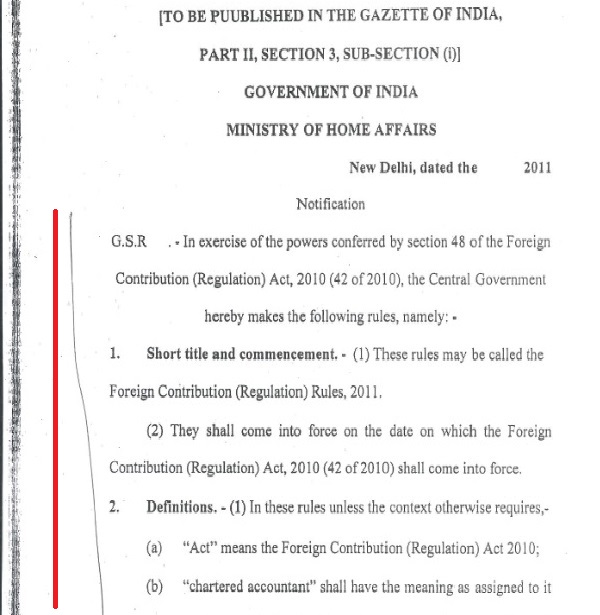
Among the many allegations made on KABIR is the funding made by Ford Foundation to the organization in the year 2011 when the Janlokpal movement started. According to various news paper reports and KABIR’s own testimony, it participated actively in the Janlokpal movement. The Foreign Control Regulation Act of India, 2010 prohibits any foreign funding to Indian political organization or the organizations with political nature. The law states that the following persons are prohibited from accepting any kind of foreign contribution:

(a) Candidate for election;
(b) Correspondent, columnist, cartoonist, editor, owner, printer or publisher of a registered newspaper;
(c) Judge, government servant or employee of any entity controlled or owned by the government;
(d) Member of any Legislature;
(e) Political party or its office bearers;
(f) Organisations of a political nature as may be specified;
(g) Associations or company engaged in the production or broadcast of audio news or audiovisual news or current affairs programmes through any electronic mode or form or any other mode of mass communication;
(h) Correspondent or columnist, cartoonist, editor, owner of the association or company referred to in (g) above.

When Kavitha N Ramdas, the present Indian representative of Ford Foundation was reached for an official comment she replied, “In 2010, the foundation reviewed a new grant proposal from KABIR for similar activities. We approved this second grant in February, 2011. However, KABIR notified the foundation in September 2011 that it was not capable of carrying out the planned activities due to an emerging campaign to mobilize the public around anti-corruption efforts. Based on this information from KABIR and the foundation’s own fiscal year schedule, the foundation amicably rescinded its second grant in February 2012, against which no funds had ever been distributed. The rescinded and unpaid grant was then removed from our web site.” She also thanked the writer for bringing this correction to foundation’s notice. When a more detailed answer was sought, the director of Communications, Ford Foundation, Newyork, took on the matter further. He is yet to reply with the details.

On foundation’s association with KABIR, she said, “The foundation’s first grant to KABIR was made in 2007 and was for $197,000 over three years. The grant supported the organization’s efforts to produce training materials on India’s Right-to-Information law, to disseminate information about the effective use of the law, and to help promote transparent and accountable governance. These efforts were carried out satisfactorily and the grant was closed on schedule.”

In her reply Mrs. Ramdas forgot to add the grant made to KABIR in the year 2005, for enabling a ‘media initiative’ to popularize the right to information act, 2005.

But it is very well documented in the foundation’s annual report of the year 2005-06 attached with this post. The president of KABIR has candidly or rather unknowingly confirmed the use of this grant in tying up with various media houses of the country. It is very surprising to see that the Home Ministry provided this NGO with a FCRA license even when the foreign funding to the Indian media is strictly banned under FCRA, 2010.

KABIR’s Annual Report of 2006-07 reveals that it started two media campaigns called Drive against Bribe (Ghoons ko Ghoonsa) and ‘Save the RTI campaign’ from the money given to it by the Ford Foundation:

The Drive Against Bribe Campaign (1st July to 15th July 2006)

Kabir in partnership with one of the highest TRP rated news channels NDTV, newspapers like Hindustan Times, Hindustan (Hindi) and The Hindu started planning for a campaign to promote the use of the RTI Act, 2005 amongst the masses. At the same time the print media at the regional level also joined the campaign. Consequently, 8 media houses publicized right to information in their news dailies and news channels. They are  The Successes received from the use of Right to Information were being telecast in the form of advertisements and news stories on various news channels from the first week of June itself. Kabir not only collected such success stories but also coordinated their reporting on various print and electronic media. (From Kabir’s Annual Report 2006-07)

Save the RTI campaign

“The Drive Against Bribe Campaign was still in its follow up stage and the success stories were still being recorded when the Cabinet gave a green signal to the amendments in the RTI Act, 2005. Kabir and Parivartan sensitized and mobilized both the conventional and the unconventional media across the country and called for a press conference in which Annaji announced that many more protest meetings and briefings will be organized on the issue. In the mean time protest demonstrations against the amendments began at Jantar Matar in Delhi. Kabir actively participated in the protest activities along with organizations like NCPRI, Parivartan and MKSS. (political agitation mentioned in the Home Ministry Report) Kabir zealously collected successful examples of RTI Act implementations and disseminated them to the masses through various media to explain that such achievements would not be possible if these amendments were implemented.” (from Kabir’s Annual Report 2006-07)

The nature of these media partnerships remains unclear because Kabir has lost its cashbook for the same period 2006-08. The MHA has reported in its investigation reports that ‘Cash Books w.e.f 2006-08 is not available with the association. As per statement of Mr. Manish Sisodia, the cashbook has been lost somewhere due to shifting of office. It is again questionable that vital documents like the cashbook have been lost. From the perusal of details in the years when the cashbook was maintained i.e 2008-09 to till date, it has been observed that most of the expenditure has been incurred in cash. In the absence of cashbook, the genuineness of the expenditure can’t be ascertained.’ (Home Ministry report, point no. 11, page 8 of 14) When some of the associated media organizations were reached for a comment, they chose not to respond.

RTI and ‘The Foreign Hand (From The Right to Information Act in India: The Turbid World of Transparency Reforms, A thesis submitted to the Department of International Development of the London School of Economics and Political Science for the degree of Doctor of Philosophy, by Prashant Sharma)

“An issue that arose consistently in the critiques of the mainstream narrative of the RTI movement is the resources needed to finance such campaigns. The Ministry of Home Affairs also constituted an Inter-Ministerial Task Force to develop a draft bill on the right to information, which was also tasked inter alia to conduct a survey of the ‘foreign experience’. “It was a Joint Secretary level committee, only officials and non political figures. That committee went to a few countries and thereafter it gave its report in two volumes. Somehow that report came into my hands, one volume only, and I requested the Home Ministry to give me the other volume, and give me the files on which this committee was constituted, the recommendations they made, and what was the decision of the Home Ministry on those recommendations. They said they have no papers on the subject. I didn’t get anything except one volume, in which they only had copies of the legislations which they had collected from other countries.” Whether the ‘disappearance’ of the second volume was by design or simply a result of poor record management, the familiar trope of the political executive being stymied by the bureaucracy reappears here. “In conversations many years later, V.P.Singh revealed that though he had tried to get a suitable act drafted and introduced in Parliament, the bureaucracy had frustrated him at every step”. Eventually, V.P. Singh’s abilities to outmaneuver the bureaucracy on this issue remained untested, as his government did not last long enough.”

“In sum, the existing explanatory narrative around the RTI Act in India proposes that the Indian experience is particularly noteworthy as not only can its roots be traced to the dusty weather-beaten paths of rural India, but also because the process was divorced from any perceptible international influences or trends. It is this defining characteristic of the Indian ‘struggle’ for an RTI Act that accords it an almost mythical status within FoI-related advocacy, academic and activist spheres. Top-down, elite-led, externally influenced democratic ‘deepening’ after all, presents a far less attractive image compared to a bottom-up local struggle that succeeds in wresting power from above.”

This particular version of the ‘truth’ calls out for deeper examination, not least because of the timing of the enactment of the RTI Act in India. In 1990, only fourteen countries had some sort of a law that provided citizens with a formal and legal procedure to access government information. In 2010, this number stood at eighty four.441 In addition, another fifty countries seem to be on their way to enacting such legislation.442 Some international organisations, including the World Bank, have of late begun to draft disclosure policies somewhat on thelines of national FoI laws. Clearly, there seems to be a well-established global trend of adopting national (and international) FoI legislation and policies across the world, particularly over the last two decades.

An early clue in this direction can be discerned in the enactment of state level FoI laws in India that preceded the national FoI Act of 2002 and the RTI Act of 2005. The specific case relates to the southern state of Karnataka. “[The CHRI] had a major role to play in Karnataka, where there was no people’s movement for RTI, but ADB [Asian Development Bank] was giving a loan, and they said, ‘conditionality’ – have an RTI law. So B.K. Chandrashekhar who was the Information Minister, he knew CHRI was working [on this issue], and he called [them] over, and they sat and drafted the law, not a terribly good law, but definitely not as bad as the Tamil Nadu one.” As a result, the Karnataka Right to Information Act was enacted in 2000. Soon after, in 2001, the President of the Asian Development Bank recommended the grant of a loan of USD 200 million for “infrastructure projects in specified infrastructure sectors in four selected Indian states: Andhra Pradesh, Gujarat, Karnataka, and Madhya Pradesh”

A similar logic also played out at the national level, albeit in less obvious ways. An important element that informs the allocation of World Bank funds (lent at preferential rates for low- income countries) under its International Development Association (IDA) programme is based on its Country Policy and Institutional Assessment (CPIA) framework. The CPIA rating for India in 2003 included a section on “Transparency, Accountability and Corruption in the Public Sector” where it stated that “Corruption remains a significant problem. India ranked 71 out of 102 in the Transparency International’s Corruption Perceptions index… With the passage of the Freedom of Information legislation in March 2003 [sic], the GoI has followed in the path of some leading states and taken a significant step forward in improving the legal framework for transparency and this increase in rating reflects that… The effective implementation of this act will remain a major challenge in the next several years…”501 With rewards such as ‘increased ratings’ in the CPIA framework on offer, it comes as no surprise that the Ministry of Finance sent several missives to the DoPT seeking its input on the status of the implementation of the FoI Act to be able to respond to the assessment exercise of the World Bank.

“I think perhaps around 30%-40% of the contribution for bringing the Act was the World Bank and the international community’s pressure on the government, which most of us normally don’t like to acknowledge. My own perception is that the Prime Minister of India unfortunately is fairly influenced by these factors. The World Bank and various international organisations were pressing to get in more transparency, less corruption. This is part of a worldwide agenda they have – they want to do business, they want these as essentials.” (for more read the thesis attached with this post)
In such a scenario Kabir’s activities related to the right to information act of India is heavily objectionable. Its Save the RTI campaign challenged the advice of the then president Dr. APJ Abdul Kalam to the Prime Minister Manmohan Singh. Incidentally, while giving his approval to the RTI Act in June 2005, President APJ Abdul Kalam, had emphasised that notings by bureaucrats on files should be privileged, otherwise it could affect the decision-making process. The logic being that the senior bureaucrats would be more interested in covering their backs rather than being forthright. In a communication to the Prime Minister, he had also suggested that the Act should not have a purview over communications between the Head of State and the Head of Government and that the documents emanating from the President’s secretariat were not not brought within the ambit of the Act. Accordingly, in December 2005 (only a month after the RTI Act came into force), Prime Minister Manmohan Singh instructed the Department of Personnel and Training (DoPT) that ‘file notings’ relating to identifiable individuals, group of individuals, organizations, appointments, matters relating to inquiries and departmental proceedings, should not be disclosed.

Similar objection were raised by the then Parliamentary Affairs Minister Priyaranjan Dasmunsi , “The Union Cabinet has decided to amend the RTI Act to correct “certain ambiguities” and it is based of the objections raised by some government organisations such as UPSC who had objected that while decisions taken could be conveyed, the details and the process as to how the decisions were arrived at could not be: “Decisions can be conveyed, not in terms of details about what the Under Secretary or Joint Secretary wrote or what the Secretary disapproved.” The minister had also claimed that such exemptions also exist in the systems followed by the US, UK and Australia as well.”
Effectively, KABIR’s campaign voiced against the proposed amendments in the RTI campaign which is a democratic right in this country. But it also enabled a media campaign in the country where it severely criticized its own government and democratic institutions using the foreign funding from an organization who is suspected to have links with the CIA. (Please refer to The Ford Foundation and the CIA: A documented case of philanthropic collaboration with the Secret Police by James Petras 15 December 2001) When this reporter sought a comment from the Ford Foundation for its suspected links with CIA, it’s Director of Communication, Newyork never responded back.

During the ‘Save the RTI’ media campaign a series of editorials were written across the newspapers in the country supporting Kabir’s stand on file notings in the RTI act. Kabir’s president says these editorials were written by its in house media team which was passed on the media houses. For a full list of editorials written on the RTI campaign please visit http://rti.aidindia.org/content/blogcategory/25/100/. While nothing can be proved in absence of cashbook for the same period, a detailed inquiry is a must sought to justify the intentions of these articles.

NDTV’s partnership with Kabir deserves a special mention. Starting with KABIR in 2006, they were involved in all its media campaigns. They also announced National RTI Awards in association with Public Cause Research Foundation (PCRF), an organization set up by Magsaysay awardee Arvind Kejriwal to acknowledge those who have displayed exemplary commitment to RTI Act. In 2011, NDTV went on to give Arvind Kejriwal and Anna Hazare the Indian of the year award.

Similarly a host of newspapers also borrowed news from Kabir, remembers an old time associate of Kejriwal. “He [Arvind Kejriwal] was directly involved with editors and proprietors of these newspapers. After the media campaign, members from Kabir became regular at newspaper offices. Specific RTI beats were created within newspapers which are now filing 30 RTI applications in a single day, less is known about the petitions which don’t make it to the newspapers.” This member was once part of Arvind Kejriwal’s movement Parivartan but he left the group in 2004 on the issue of foreign funding from the Ford Foundation. Parivartan then had a rule that no outside institutional funding will be accepted by the organization.

The Home Ministry report also notes that amount of Rs. 17,68,261/- has been paid to different RTI activists throughout the country between the years 2008 to 2011-12. However, no agreements between the individuals and association were made available to the inspection party. (Home Ministry Report, Point no. 8, page 8 of 14)

Less is known about centre’s motivation to rid KABIR of serious charges reported by the home ministry investigation. But the report itself falls short of mentioning anything about the organizations working during the Janlokpal movement, for which the inquiry was sought by the petitioner. There are also no references about Ford Foundation in the report. With just a month before the election, who is it that the Indian government trying to save?

What is it trying to save? – KABIR, Ford Foundation, its own media or the false sense of democracy in the country.

Please click the links mentioned below accordingly for details….
1 ) Inspection of Foreign Contribution Records pertaining to an NGO KABIR (2005-06 to 2011-2012)’
2) Kabir – Annual Report 2006-07
3) kabir – registration certificate
4) The Right to Information Act in India and The Turbid World of Transparency Reforms By Prashant Sharma
Thanx,
BIRBAL….

Source: http://rajuparulekar.wordpress.com/2014/03/11/conspiracy-unfolds-kejriwal-others-shocking-revelations/

HORROR OF GANG KEJRIWAL: SEDITION, NEXUS AND CO-EXISTENCE

NEW DELHI: BJP would, if elected, roll out a programme to boost farm efficiency that its prime ministerial candidate, Narendra Modi, has championed in his home state of Gujarat.

The Bharatiya Janata Party (BJP), which opinion polls show winning the most seats in a general election, is pushing a range of market reforms to differentiate it from the Congress-led government's focus on subsidies.

"A market-centric policy would make the promotion of self-reliance a top priority," sai ..